
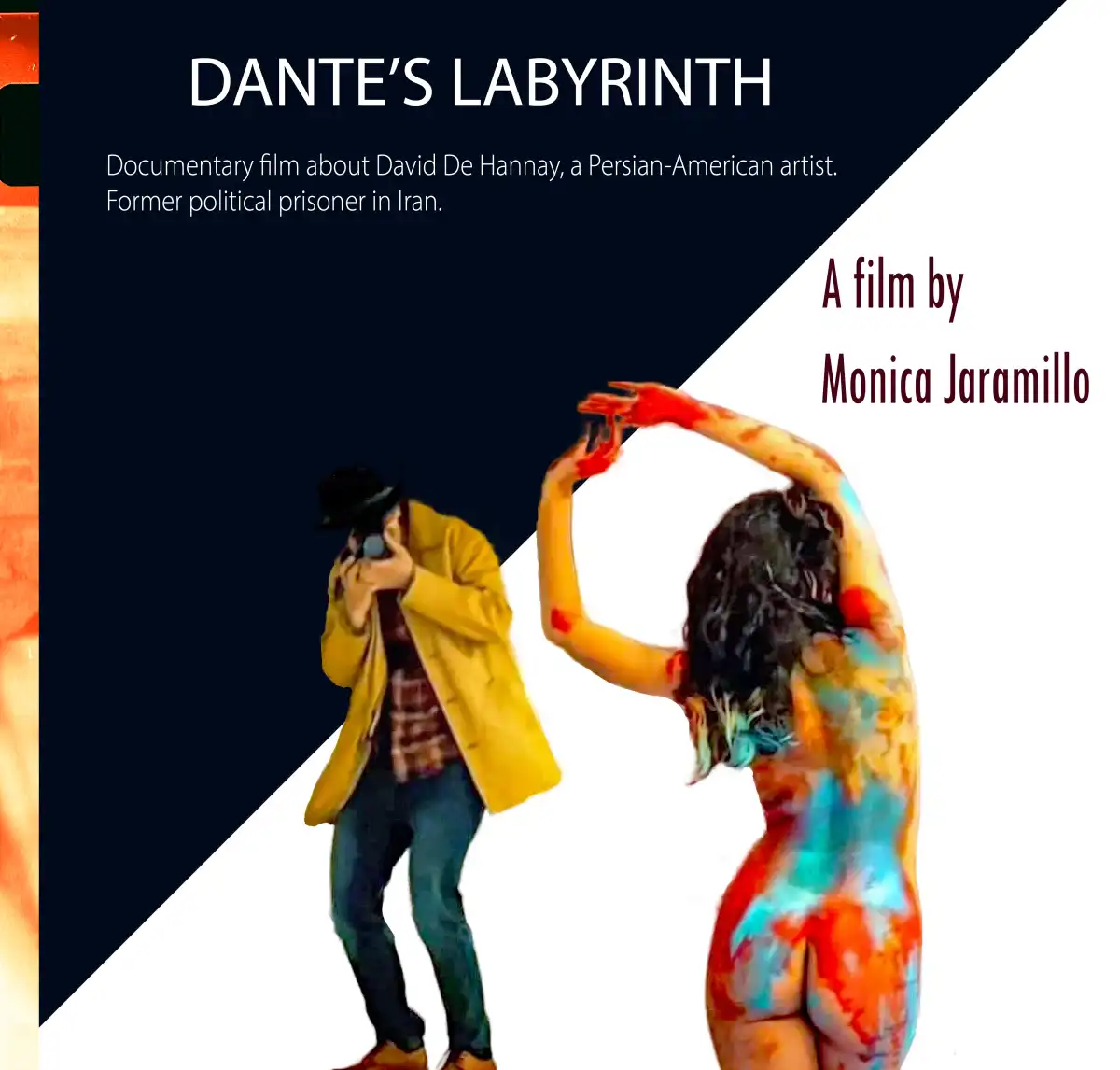
In a city where identities overlap like layers of the same conversation, a Colombian director decided to follow the life of a Persian-American artist and ended up building something closer to a crossing of worlds than to a traditional documentary.
Dante’s Labyrinth, directed by Mónica Jaramillo (Monijara), is born precisely from that intersection: a Latin American gaze observing a creator born in Iran and trained in the United States, in a city that seems designed so that stories do not belong to a single place.
New York is not just the setting. It is the point of friction and meeting. It is where a Colombian director can enter the universe of a Persian-American artist and discover that, in the end, the questions are the same: memory, identity, violence, creation, survival.
The film’s protagonist, David De Hannay, is a visual artist, photographer, writer and filmmaker. Born in Iran and based in the United States, since 1999 he has built an extensive visual archive of his country of origin, work that has been internationally recognized, including coverage by BBC World News. His history is also marked by repression: he was detained and tortured in Iran for his photographic work.
In New York, during the pandemic, he founded the NYC Art Movement, a space that brought together more than 120 artists in one of the city’s quietest moments, when art seemed to have stopped along with everything else.
But the movie doesn’t start with him. It starts with her look.
“I made this film by assembling fragments—archives and the work process as it unfolded,” explains Monijara. His approach was neither distant nor academic. It was a prolonged immersion in different territories: Paris, London, New York and Colombia, where the camera became a kind of moving notebook.
The director met De Hannay in New York, at an exhibition organized in support of Ukraine. “What marked me was his refusal to separate art from human reality,” he recalls. That gesture, more than any work, was the starting point of the documentary.
From there, the relationship between the two became a shared process: exhibitions, trips, conversations and creation in real time. The camera does not observe from the outside; accompanies from within.
The film also records a critical moment: the protests in Iran in January 2026 and the violent response of the State. In the midst of this context, De Hannay creates Silent Slaughter, a short film made with clandestine material that goes through the urgency of the present.
“At that moment, seeing the impact and how rare and necessary an independent voice like hers is, I finished this film,” Monijara says.
In its structure, Dante’s Labyrinth rejects the idea of a closed biography. “This film is not a biography. It is a record,” says the director. A living, incomplete record that prefers experience to narrative closure.
About her protagonist, Monijara does not speak in distant terms. “I consider him one of the most significant conceptual artists of our time,” he points out, before adding a comparison that opens another layer of reading: “It reminds me of Un uomo (A man) by Oriana Fallaci.”
But perhaps the most revealing thing about the project is not only the artist, but the space where everything happens. New York appears as a third character: a city where the Colombian, the Persian, the American and the global not only coexist, but mix until they become indistinguishable.
At that intersection, the film finds its form.
Monijara, based in New York, has spent more than two decades moving between technology, innovation and the corporate world. Today, through cinema, it moves in another type of architecture: that of stories that do not belong to a single country, but to the constant tension between several.