
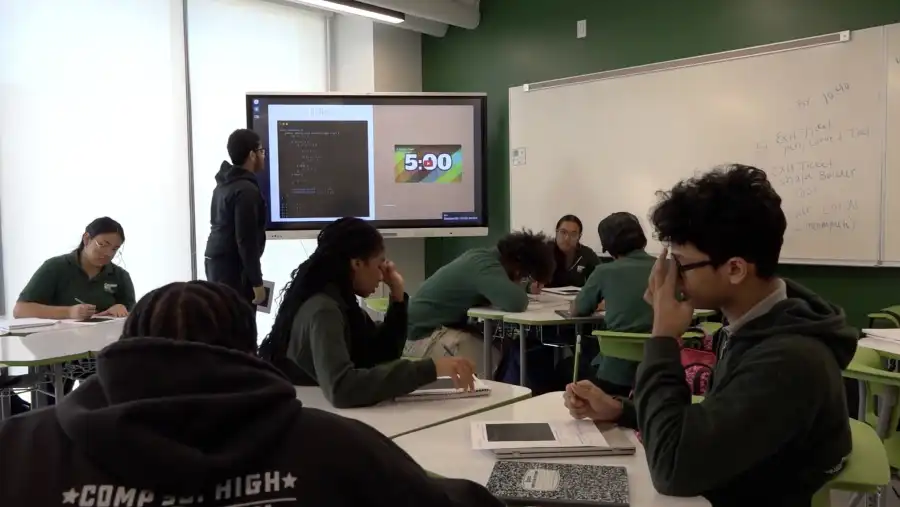
The idea behind Comp Sci High—a charter school focused on computer science education for mostly African American and Latino students in the South Bronx—took shape in 2017. A year later, with the backing of its founder David Noah, the school opened its doors in one of the most economically disadvantaged neighborhoods in New York City.
From the beginning, the school set an ambitious goal.
“We want every student to reach the national median family income by age 25,” said Noah, CEO of Comp Sci High. “Because that represents how much money you need to have true choice about where to live, what to eat, what to do and what schools to send your children to.”
Today, Comp Sci High serves approximately 500 students. But as the school continues its mission to promote economic mobility through technology, it faces a new and rapidly evolving challenge: the rise of generative artificial intelligence, a force that is transforming both education and the technology industry itself.
For students like 11th grader Kenneth Núñez, the presence of AI is already inevitable.
“Nowadays there is not much you can do without using AI,” Núñez said. “Even if you don’t use it, your employers will probably force you to. And when AI is good enough, there may not even be a need for programmers.”
Instead of resisting technology, Comp Sci High has decided to confront it head-on. Shilpa Agrawal, head of the school’s computer science department, is leading a comprehensive effort to prepare both students and staff for a future powered by artificial intelligence.
“We are launching a comprehensive AI literacy curriculum with all of our students in all four grades,” Agrawal said. “We are also incorporating AI into programming practices, because that is what the industry is doing.”
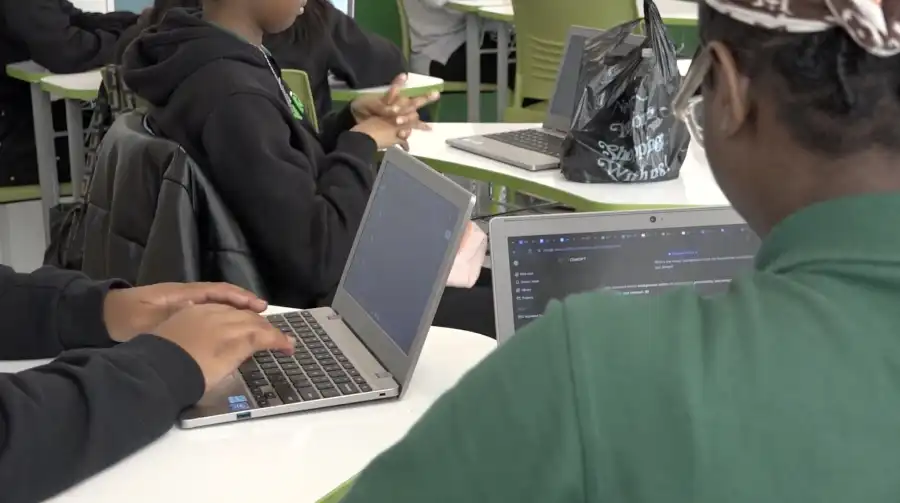
The approach, Agrawal explained, is intentionally gradual. Students are first required to master fundamental programming skills through traditional instruction before they can use AI tools.
“But once they have mastered those topics,” Agrawal explained, “in many cases our classes allow them to generate code using AI for the topics in which they have already demonstrated mastery.”
The rapid pace of technological change can be intimidating for educators and students alike. Still, Agrawal remains optimistic that adaptability—rather than fear—will determine long-term success.
“Ultimately, the world will look different when you graduate from high school and when you graduate from college, four and eight years from now,” Agrawal said.
“As long as you follow those trends, as long as you understand and move with that evolving world, you’ll be fine.”
-Liam Kahan is a journalism student at NYU.