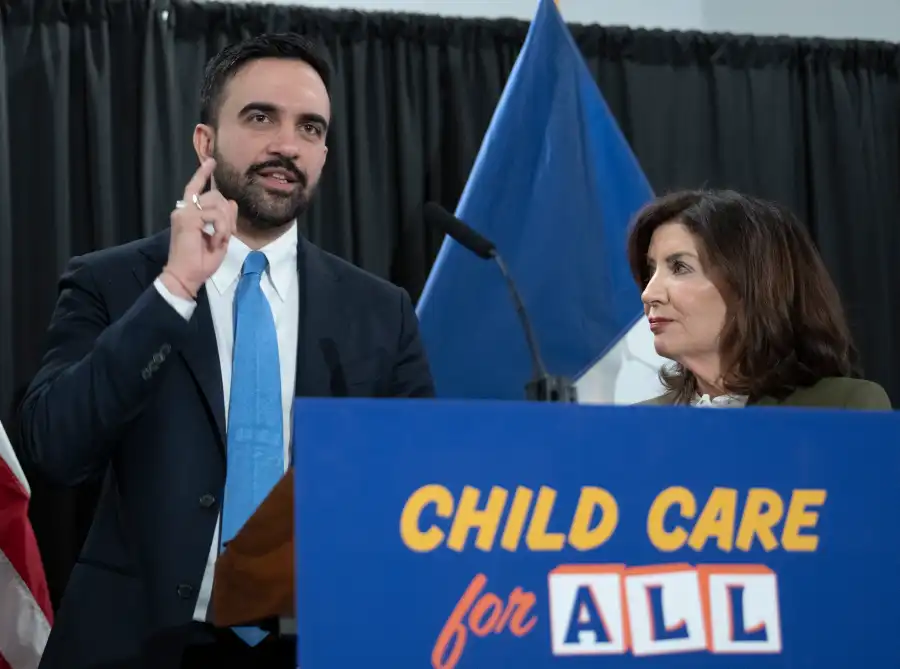
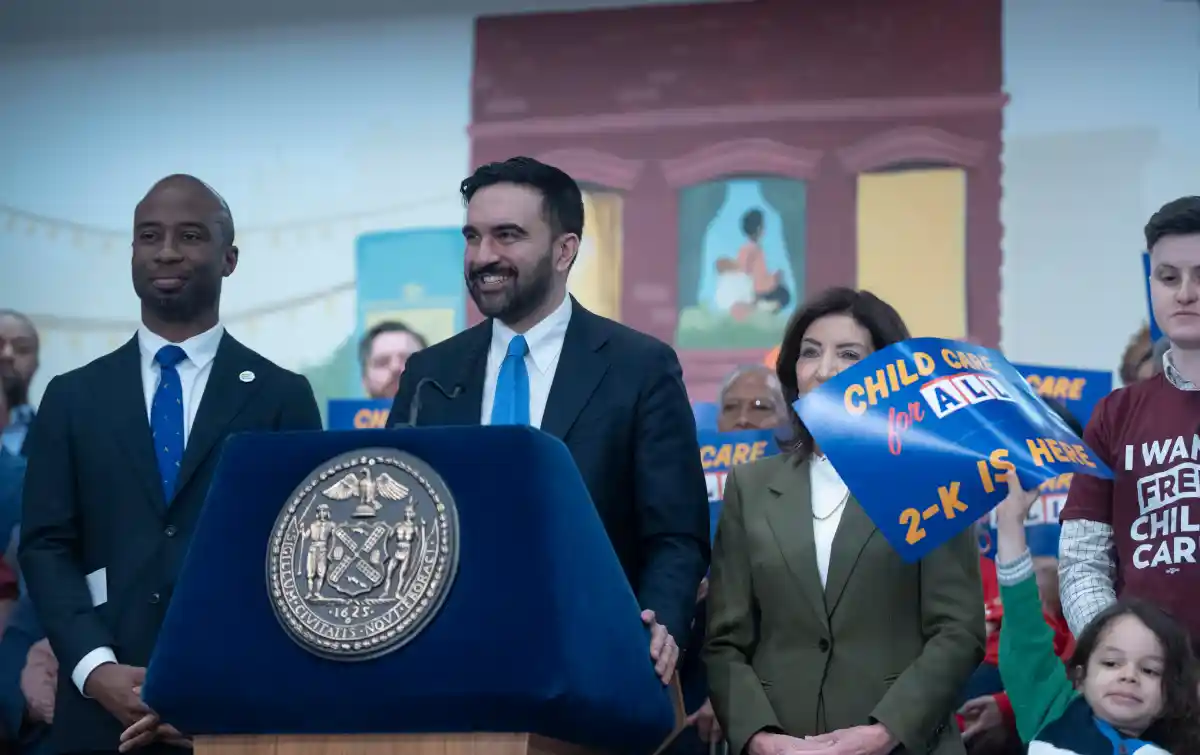
This fall, two thousand young children in New York City will receive free, full-day child care under the first phase of Mayor Zohran Mamdani’s “2K” program, with spots concentrated in neighborhoods he says have the greatest economic needs and gaps in access to child care.
The expansion, announced Tuesday with Governor Kathy Hochul, will offer more than 2,000 free seats in four school districts in Upper Manhattan, the Bronx, Brooklyn and Queens.
The first districts include School District 6 in New York, which encompasses Washington Heights, Inwood, Hamilton Heights and parts of Manhattanville in northern Manhattan. In the Bronx, School District 10 covers Fordham, Belmont, Norwood, Marble Hill, Morris Heights, Riverdale, Spuyten Duyvil and Van Cortlandt Village, as well as sections of Kingsbridge, Kingsbridge Heights, Bedford Park, Mount Hope, Claremont-Bathgate and East Tremont.
In Brooklyn, School Districts 18 and 23 include Canarsie, Rugby–Remsen Village, Brownsville, and Ocean Hill, as well as parts of East Flatbush–Farragut and Prospect Lefferts Gardens–Wingate. Finally, School District 27 in Queens encompasses Ozone Park, South Ozone Park, Richmond Hill, Woodhaven, Howard Beach and the Rockaways, plus sections of Lindenwood and Springfield Gardens North.
To apply, parents are only required to live within the applicable school district, regardless of income, occupation or immigration status, Mamdani said. The application process will open “in early summer,” he added.
The mayor explained that phase one districts were selected based on economic need, projected demand, existing access gaps, provider capacity, and readiness to hit the ground running.
“We are able to offer 2,000 spaces this first year thanks to collaboration with existing child care providers. These decisions were made considering which neighborhoods had providers ready before the end of the year and also reflecting economic need,” Mamdani said, adding that similar criteria will apply when Phase 2 expands to 12,000 spaces next year.
The new “2-Care” program, announced on the eighth day of the Mamdani administration, seeks to expand citywide within four years as part of a push toward universal child care from six weeks to five years. At the end of the four-year program, “every two-year-old in New York” will be able to secure a free spot in their district, according to the mayor.
In the coming days, the city will begin planning efforts with child care centers and family providers in the four selected areas, with additional details on participating providers in the coming weeks.
Mamdani acknowledged that demand could outstrip supply in this early phase. When asked how spots will be allocated if there are more families applying than spaces available, Emmy Liss, executive director of the Mayor’s Office of Child Care and Early Education, said, “When we launch the application process in the coming months, we will explain how families will be able to apply and how we will resolve cases, similar to pre-K 3K admissions.”
Liss also mentioned before the City Council that key operating systems, from permitting to staffing planning, are still being built as universal child care expands. He noted that the city is moving “as quickly as it can” to address the urgency of working families, while ensuring a sustainable system with “deep collaboration with providers, both centers and care homes in the communities.”
The launch features more than $1.2 billion in state funding for early childhood education in New York, including $73 million to fund the first round of 2K seats. The investment is expected to grow to $425 million next year.
Since presenting his preliminary budget last month, Mamdani has continued to advocate for the state to raise taxes on the richest and most profitable corporations to cover current deficits and fund future programs. Governor Hochul, up for re-election, has stated that she will not support such measures and reaffirmed that commitment on Tuesday.
When asked if new taxes would be necessary to sustain the program, Hochul assured that the state can finance it with current revenues: “We have managed our budget very well and we can offer this new program with current revenues. We hope for the same next year and beyond, because it is a priority of mine, and as long as I am governor, it will continue to be a priority. We are not going to back away from our commitment.”