
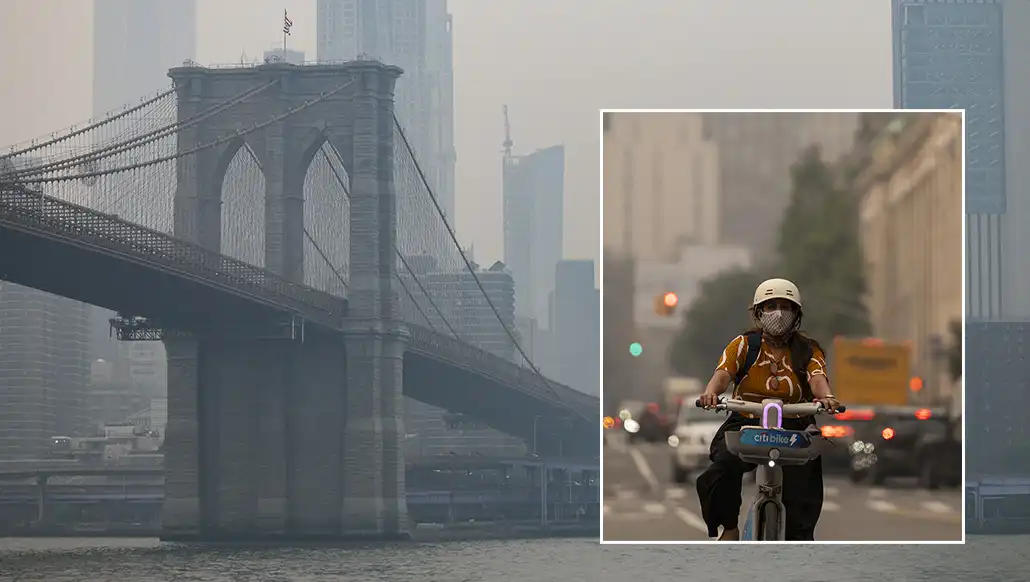
The forest fires ravaging Canada continue to bring large plumes of smoke to parts of the United States, including New York, that keep large areas of the country on alert due to their effects on air quality.
The National Weather Service (NWS) maintains widespread air quality advisories across much of the Great Lakes region, into New England and the Mid-Atlantic.
In total, more than 100 million people in 18 states and the District of Columbia are under these alerts due to the presence of fine polluting particles from smoke from fires.
There are currently more than 800 active wildfires in Canada, and smoke continues to move southward driven by winds.
This situation threatens to affect the final match of the Soccer World Cup 2026which takes place this Sunday, July 19 (3 pm ET) at the New York/New Jersey headquarters and in which Spain and Argentina will face each other.
Although forecasts point to a possible improvement in conditions before the match, this Friday the Air Quality Index (AQI) in New York stands at a level of 179, defined as “unhealthy.”
The city has set up points where citizens can purchase masks for free, such as the Public Library headquarters in Bryant Park
DEC and @HealthNYGov have issued an updated air quality health advisory for today, July 17th, for fine particulate matter due to the impact of smoke from wildfires in Canada. New Yorkers may see visible smoke and hazy skies across the state and spikes in smoke-related pollution. pic.twitter.com/QAuHTCybjU
— New York State Dept. of Environmental Conservation (@NYSDEC) July 17, 2026
The governor of New York, Kathy Hochul, indicated that the region is “in a very serious health situation.”
The smoke is now moving south of New York state, although the NWS expects conditions to improve over the weekend with the arrival of rain and changes in wind patterns.
The state Department of Health recommends that at these pollution levels, people consider limiting vigorous outdoor physical activity to reduce the risk of adverse health effects.
Citizens who may be especially sensitive to the effects of this pollution include very young children and people who suffer from respiratory problems such as asthma or heart disease.
Fine polluting particles
In this way, the Commissioner of the Department of Environmental Conservation (DEC) of the State of New York, Amanda Lefton, and the Commissioner of the Department of Health (DOH), Dr. James McDonald, issued an updated health advisory on air quality due to the presence of fine particles for Friday, July 17, 2026, due to the impact of smoke from the wildfires in Canada.
New Yorkers may see visible smoke and hazy skies across the state, as well as spikes in smoke-related pollution levels.
The regions of Long Island (including Nassau and Suffolk counties), the New York City metropolitan area (including the NYC boroughs of Manhattan, Queems, Brooklyn, the Bronx, Staten Island, and Rockland and Westchester counties), the lower Hudson Valley, and eastern Lake Ontario are expected to reach “unhealthy for sensitive groups” levels.
The contaminant of interest is: fine particles. Fine particulate matter (PM) consists of tiny solid particles or liquid droplets suspended in the air, with a diameter of 2.5 microns or less.
PM 2.5 particles can be made up of various types of particles and often come from combustion processes (such as vehicle exhaust, power plants and fires) and chemical reactions in the atmosphere.

Exposure can cause immediate health effects such as eye, nose and throat irritation, coughing, sneezing, runny nose and difficulty breathing.
Exposure to high levels of fine particulate matter can also aggravate pre-existing medical conditions, such as heart disease and asthma.
People with heart or respiratory problems, older adults, children and teenagers, pregnant people, and those who exercise or work outdoors may be especially sensitive to PM 2.5. When outdoor levels are high, staying indoors can reduce exposure.
To stay up to date with DEC announcements, subscribe to receive alerts about air quality through “DEC Delivers”, the agency’s main email service.
DEC has also set up a toll-free air quality hotline (air Quality Hotline 1-800-535-1345) to keep New Yorkers informed about the current situation.
Among other affected places in the US are Washington DC, which is today the epicenter of air pollution on the east coast of the country, with an AQI of 237, classified as “very unhealthy.”
Likewise, there are Virginia, Cloquet and Duluth, in Minnesota, as well as Northbrook (Illinois), Columbus (Ohio), Milwaukee (Wisconsin) or London (Ontario), where the air quality is at a level between 450 and 928 according to the AQI index, categorized as “hazardous.”