
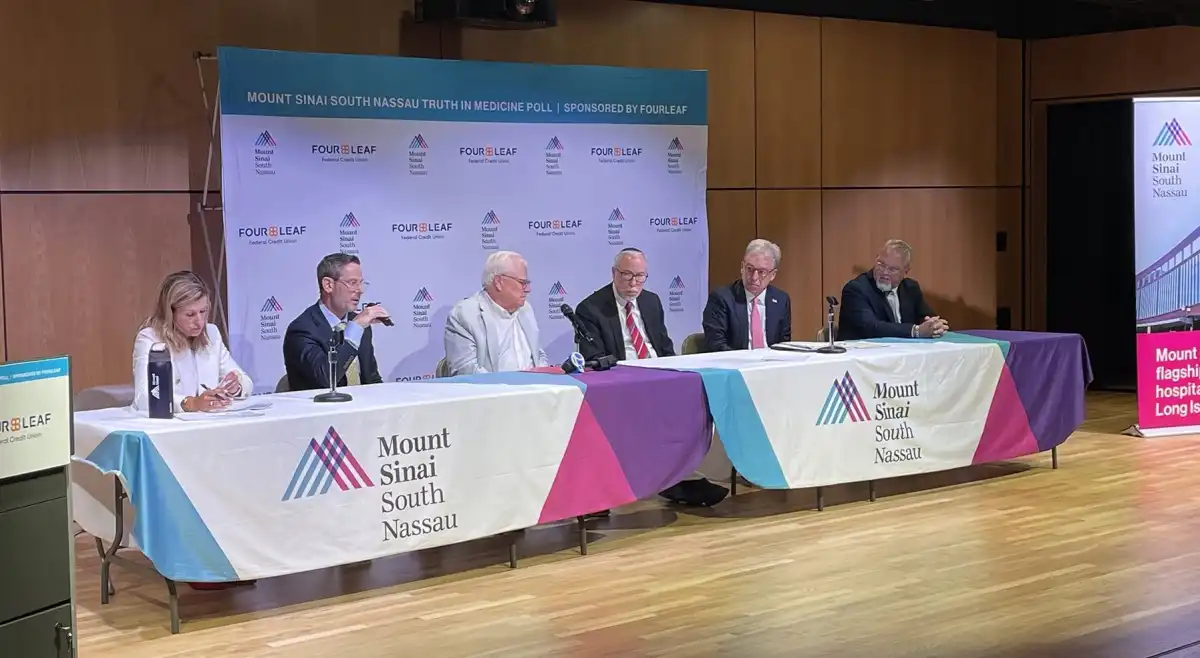
Twenty-five years after the terrorist attacks of September 11, 2001, the majority of participants in the Mount Sinai South Nassau “Truth in Medicine” survey say the emotional impact is still alive and “on the surface.”
Among respondents in New York City and Long Island who were 21 or older at the time of the attack, 73% say the tragedy of 9/11 remains vivid in their memory: 34% feel as if it “happened yesterday,” and 39% agree that even though it happened a quarter-century ago, they continue to feel its impact daily.
On the other hand, a large majority (77%) believe that schools should be required to teach students about 9/11 and its aftermath; Likewise, 87% of those surveyed believe that the federal government should continue funding the program that offers free medical follow-up and treatment to people with certified health problems related to 9/11.
“Twenty-five years later, the trauma of 9/11 continues to have significant long-term impacts on the physical and mental health of our community,” said Dr. Joshua Kugler, MD, MHCM, interim president of Mount Sinai South Nassau.
“We must maintain our work of defense and support for our friends, first responders and neighbors who still suffer the physical and mental consequences of that day that changed our world forever,” he stressed.
The “Truth in Medicine” survey, sponsored by FourLeaf, is the only hospital-driven public health survey in the metropolitan area that seeks to measure public opinion on relevant health issues and encourage debate and education around these issues.
The survey, conducted among 600 adults ages 30 and older living in NYC and Long Island, was conducted by LJR Custom Strategies—a national independent pollster—between August 5 and 10, using both landlines and mobile phones. The survey results have a margin of sampling error of plus or minus 3.9 percentage points.
Other notable findings from the “Truth in Medicine” survey include:
– Most respondents consider the United States to be less safe today than before 9/11 (27% say it is somewhat less safe and 33% say it is much less safe).
– About two-thirds of those surveyed believe that the spirit of unity the country felt after 9/11 has dissipated. These respondents perceive a more divided country; 33% believe that unity has completely disappeared, while 35% maintain that the country can still unite in the face of a major crisis, despite its divisions.
– Regarding education, the majority of respondents indicate that schools should teach topics such as: the value of national unity; volunteering and resilience; the evil of global terrorism and the motivations of terrorists; the historical chronology and political repercussions of the attacks; and the heroism of first responders and ordinary citizens.
Traumas or disorders
More than 75% of respondents who are currently 46 years old or older (i.e., who were 21 years old or older at the time of 9/11) continue to feel the impact of the terrorist attacks a quarter-century later.
For those with a direct link to 9/11, the psychological impact can be especially profound. 25% of those surveyed say they continue to suffer from trauma or mental health disorders resulting from the attacks.
24% indicate that a member of their immediate family suffers trauma-related effects from the events of that day. Families of first responders and people who lost someone they know report even higher rates of trauma and mental health problems.
More than a third (35%) say they have been — or have a family member who was — in the vicinity of the World Trade Center. 41% of all respondents report that they or an immediate family member was directly affected by 9/11.
Respondents in the metropolitan area who had a family member in the vicinity of the World Trade Center, who were part of the first response teams or who knew one of the fatalities (or a combination of these circumstances) were those who reported the greatest impact derived from 9/11.
Nearly two-thirds of respondents who were 21 or older at the time say they have a clear memory of that tragic day. Likewise, more than 75 percent of respondents ages 46 and older say they “still feel the impact of 9/11 on a daily basis.”
This contrasts with respondents who were under 21 years old at the time of the attacks; two-thirds of them said that 9/11 is a “vague memory” or that they “don’t remember it at all.”
Additionally, 57 percent of respondents who are currently between the ages of 30 and 45 (and who were between 5 and 20 years old on September 11, 2001) agreed that 9/11 is a “distant event that does not affect their daily lives.”
Through family, friends, or neighbors, many respondents know first responders or people who were affected, injured, or killed on 9/11; In fact, 23 percent of all respondents claim to know someone who died in the attacks. This figure nearly triples, reaching 65 percent, among respondents from first responder households.
Respondents who experienced trauma or mental health disorders associated with the attacks were also more likely to have an affected family member.
Among respondents from families affected by 9/11-related trauma, 55 percent know someone who died in the attacks, 25 percent report trauma or mental health disorders linked to the event, and 24 percent say a member of their immediate family is experiencing trauma-related effects. Of those suffering from trauma and other mental health disorders, 27 percent come from first responder homes.
“This survey confirms the transformative impact that an unspeakable and unimaginable tragedy like 9/11 can have on everyone, whether they are first responders, survivors, family members, or local residents,” said Dr. Michael A. Crane (MD, MPH), medical director of the WTC Health Program (CCE) at Mount Sinai, a leading internal medicine specialist, and professor at the Icahn School of Medicine at Mount Sinai.
“In our program, focused on the care of response teams, it is essential that we continue to provide them with adequate treatment to promote their mental, emotional and physical recovery,” he emphasized.
Help available to those affected
It should be noted that Mount Sinai, in Manhattan, is home to the largest Clinical Center of Excellence (CCE) of the World Trade Center (WTC) Health Program in the New York and New Jersey region. If you, a loved one or a friend needs help for mental health symptoms related to 9/11, call the center at 888-702-0630.
The program’s team, comprised of psychiatrists, psychologists and social workers, provides comprehensive mental health evaluations and treatments to patients, including members of law enforcement, emergency medical personnel, construction and steel workers, asbestos handlers and other first responders.
Program social workers assess overall well-being and offer basic benefit-related services. For more information, visit https://www.mountsinai.org/care/occupational-health/wtc.
The 9/11 Memorial and Museum offers educational programs for teachers and students, including a free learning experience on the anniversary of the attacks.
“It is essential to remember the sacrifices and lives lost, the pain of those who lost loved ones, and the examples of bravery, selflessness, compassion and resilience from that terrible day,” said Linda Armyn, president and CEO of FourLeaf. “We must continue teaching and learning from history to prevent it from being repeated,” he added.
This is the 30th “Truth in Medicine” survey and the second in 2026. The survey is part of Mount Sinai South Nassau’s outreach mission to improve education on critical public health issues.
Sponsored by FourLeaf, the Mount Sinai South Nassau “Truth in Medicine” survey aims to collect data on public opinion on key public health issues and encourage education and debate. Mount Sinai South Nassau began conducting the public health survey in January 2017.
Previous surveys have focused on topics such as the use of wearable health devices to maintain well-being, alcohol consumption and its relationship to cancer risk, cell phone use in schools, mental health services, holiday stress, the human papillomavirus (HPV) vaccine, recreational marijuana legalization, supplements, antibiotic use and misuse, and screen time, among others.
For more information about the surveys, visit www.southnassau.org/sn/truth-in-medicine.