
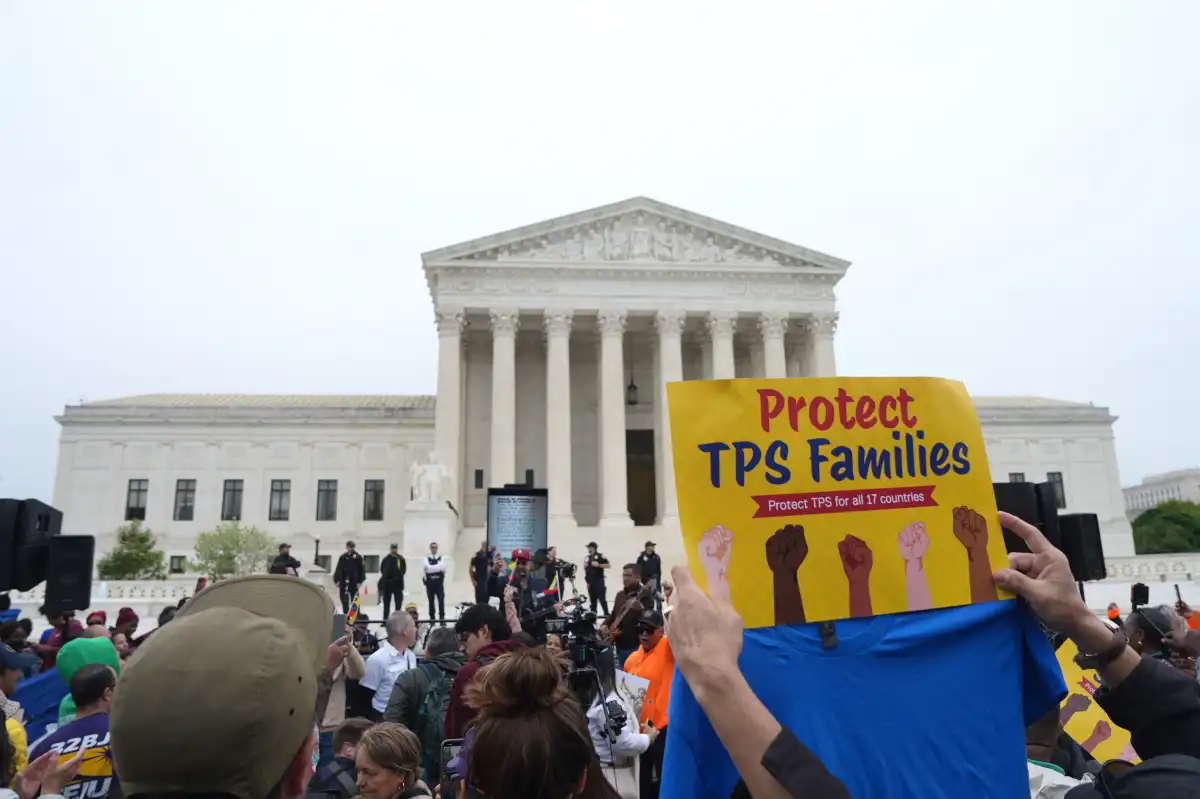
The legal team that defended before the Supreme Court the validity of Temporary Protected Status (TPS) for thousands of Haitians and Syrians in the United States, accused Donald Trump’s Government of discrimination in a hearing where the conservative majority of the court seemed to align with the Administration.
At this Wednesday’s meeting, delayed by the reading of opinions in a separate opinion on the legality of a new electoral map in Louisiana, lawyer Geoffrey Pipoly warned that while seeking to deport people from “non-white majority countries,” the US is granting asylum to white South African farmers.
During his arguments in favor of the approximately 350,000 Haitians with TPS, Pipoly described as a “farce” the reasons for ending the program given by the Government, which last year called the program “contrary to the national interest” and stated that immigrants could return to their countries safely.
Attorney General John Sauer defended the Administration’s position and faced tough questions from liberal Justices Sonia Sotomayor and Ketanji Brown Jackson, who said they did not understand how Trump’s statements about immigrants “poisoning the blood of the United States” They do not constitute a discriminatory intention.
Jackson, for his part, insisted that when Trump stated that Haitians come from a “dirty, filthy and disgusting” country, racial animosity was demonstrated.
The center of the complaint, however, is the power of the Department of Homeland Security to terminate immigration protection without consulting with other agencies before doing so.
In their questions to the Attorney General, Judges Jackson and Sotomayor addressed arguments raised by legal experts who maintain that Congress created TPS in 1990 to establish a process for humanitarian assistance, rather than leaving these decisions to the Administration in power.
The court’s conservative majority did not focus, however, on whether the Trump administration broke the law by killing the program, but rather focused almost exclusively on whether a federal court can review such decisions.
Two of the conservative justices, Samuel Alito Jr. and Neil Gorsuch, did not ask Sauer questions, suggesting they would be satisfied with the administration’s arguments.
Conservative Brett Kavanaugh pointed out that the situation in Syria is different from what existed when TPS was approved for that country. Some 6,100 Syrians could be in danger of deportation if that relief ends.
Currently, the United States has around 1.3 million immigrants from 17 countries covered by TPS and the Trump Government has overturned a large number of the protections, including those of Venezuelans, who also have an ongoing legal battle.
The Court is expected to issue a decision next June.