
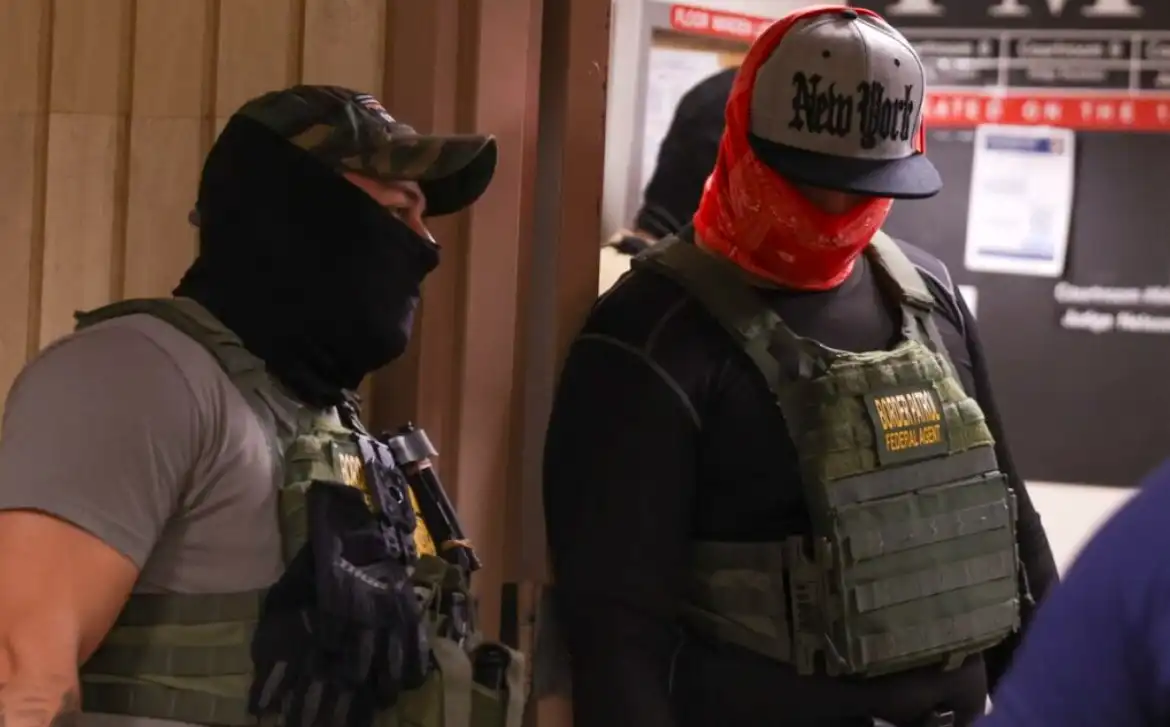
The Nassau legislators formally asked Long Island County Executive Bruce Blakeman to immediately suspend Nassau’s participation in the U.S. Immigration and Customs Enforcement (ICE) 287(g) settlement, citing growing fiscal, legal and public safety concerns.
ICE’s 287(g) program is a federal agreement that allows state and local law enforcement agencies to collaborate with immigration authorities, delegating the functions of federal agents to identify and process undocumented aliens or those with criminal records within their prisons. Nassau County, neighboring New York City, maintains a 287(g) agreement with ICE.
In a letter to Executive Blakeman, lawmakers urged a thorough review of the program’s costs, constitutional implications and impact on community trust before the county continues to cooperate under the agreement, signed last year without legislative approval.
The suspension request comes after the recent death of Honduran immigrant Santos Banegas Reyes at the Nassau County Jail.
Lawmakers said the circumstances surrounding his death, including conflicting accounts of possible alcohol withdrawal and treatment, underscore Nassau County’s potential exposure to costly litigation and liability.
“Any loss of life in our jail is tragic,” the letter states. “Plus, it is potentially costly to Nassau taxpayers.”
Lawmakers also cited recent reports that the Nassau County Probation Department is referring people with questionable immigration status to ICE before they complete court-ordered punishment and rehabilitation.
According to prosecutors and defense attorneys, this practice can undermine the criminal justice process by discouraging compliance with court appearances and probation requirements.
Beyond legal and procedural concerns, Nassau lawmakers emphasized the financial burden of 287(g) agreements across the country.
While the federal government provides training, local governments bear the cost of personnel, overtime, supervision, and related expenses.
Initially described as a program involving 10 Nassau police detectives, the program now appears to include additional police and probation personnel, which could increase costs for taxpayers in this Long Island county.
“History shows that these agreements shift financial responsibility to local governments and expose them to liability,” the lawmakers wrote.
They further warned that involving local law enforcement in federal civil immigration law enforcement could deter immigrant communities from reporting crimes or cooperating with police investigations, ultimately undermining public safety.
New York State law prohibits local law enforcement from detaining people solely for civil immigration violations. Recent court decisions across the country have placed substantial liability on municipalities for due process and constitutional violations arising from similar law enforcement practices.
Given the legal risks, fiscal uncertainties and community impacts, lawmakers argue that caution calls for a pause.
“Before Nassau taxpayers are exposed to increased liability and expense, and before community trust is further undermined, it is critical that we fully evaluate the fiscal, law enforcement, and social implications of this agreement,” the letter concludes.
Lawmakers ask the County Executive to temporarily suspend participation in the 287(g) program pending a full public review.
In response, Executive Blakeman said: “Thanks to Nassau County’s cooperation with ICE, 2,000 undocumented immigrants with criminal records have been removed from our county, making it safer,” according to reports. Lilifepolitics.com .
“New York Democrats must explain to victims of attempted murder, rape, robbery and carjacking why local law enforcement cannot coordinate with ICE to remove these dangerous criminals from our neighborhoods.”