
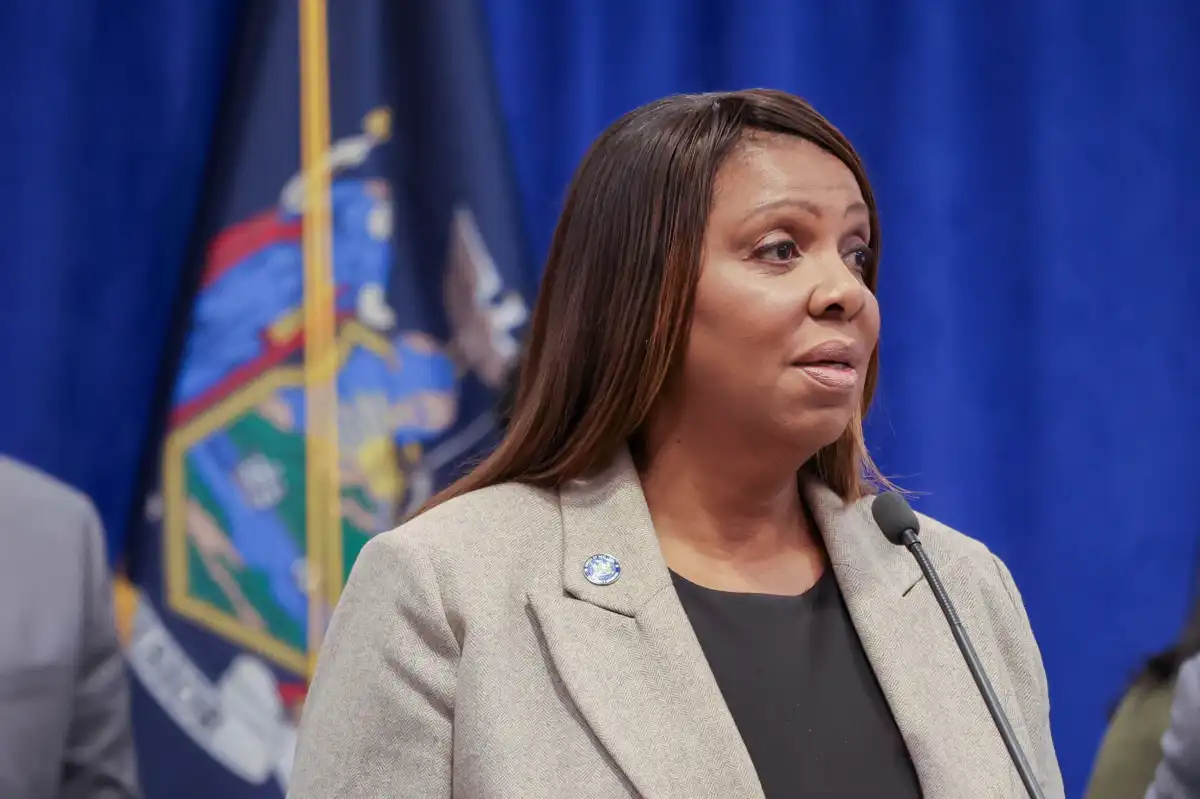
New York State Attorney General Letitia James and 21 other prosecutors sued the United States government for promoting a rule that will restrict housing aid for families with undocumented members.
The new rule from the US Department of Housing and Urban Development (HUD) could leave more than 78,000 people homeless, including tens of thousands of American children who are “fully eligible” to receive these aid, according to a statement from Letitia James.
The measure revises Section 214 of the Housing and Community Development Act of 1980, which restricts access to federally funded housing assistance based on citizenship and immigration status.
Specifically, the new rule requires verification of US citizenship or eligible immigration status of all applicants and beneficiaries of assistance under the programs subject to this regulation, regardless of their age.
It also affects the assistance currently offered to members who qualify for prorated help with their housing costs.
In the complaint, filed in federal court in Massachusetts, prosecutors argue that the rule “flagrantly” violates federal law, reverses almost 30 years of federal policy that allowed these families to “stay together” and threatens to displace people who have depended on these programs to reside in their homes.
In New York City, if this rule goes into effect, some 2,540 mixed-status families would be evicted from these subsidized federal housing, according to the statement.
Prosecutor Letitia James reports that the city’s shelter network has about 12,100 homes for families, but on a typical night there are only a few hundred of them available, so this situation “could put even more pressure on a shelter system that already has limited capacity.”
“With our country already experiencing a housing crisis, it is outrageous that the federal government is evicting more families from their homes. “This rule goes against the values of our nation and the very purpose of these housing programs,” James said.
The state of New York is leading the lawsuit, which includes the attorneys general of Arizona, California, Colorado, Connecticut, Delaware, Hawaii, Illinois, Maine, Maryland, Massachusetts, Michigan, Minnesota, New Jersey, New Mexico, Oregon, Rhode Island, Virginia, Vermont, Washington, Wisconsin and the District of Columbia, as well as the governor of Pennsylvania.
“Everyone deserves a safe place to call home. “Denying a child that security because of the people they live with is cruel and indefensible,” said Attorney General James.
“I lead this fight to protect our neighbors and keep families together, because no family should have to choose between a home and the people they love,” he stressed.
For nearly 30 years, federal housing programs have helped low-income families afford rent, even when not all household members qualify for assistance. Under this system, known as proration, HUD reduces the family’s subsidy so that it only covers household members who meet eligibility requirements.
Congress wrote this approach into law in 1997 and explicitly stated that families receiving prorated assistance “will not” lose their benefits simply because an ineligible family member lives with them.
The new HUD regulations eliminate this protection. Under this rule, a family can only stay in HUD-assisted housing if all members of the household are U.S. citizens or immigrants who meet eligibility requirements.
As a result, U.S. citizens and eligible immigrants living with an ineligible family member will be forced to choose between keeping their housing or keeping their family together.
They will lose housing assistance
HUD estimates that about 20,000 mixed immigration status families, totaling 78,100 people, will lose their housing assistance.
This includes 55,000 people who are fully eligible for federal housing assistance; the vast majority of them are children. The agency also recognizes that the regulations will lead to evictions and displacement, and that many of these families could end up homeless.
New Yorkers would be especially affected. In New York City alone, an estimated 2,540 mixed immigration status families would be displaced from federally subsidized housing.
The city’s shelter system has about 12,100 units for families, and on an average night, only a few hundred are left available. Since New York City has a legal obligation to provide shelter to people in need, this displacement could further strain a shelter system that already has limited capacity to accommodate new families.
The regulations will also make it more difficult for millions of American citizens to keep the housing for which they already qualify. Under the new rule, all U.S. citizens will be required to provide their Social Security number and consent to have their citizenship status verified through the federal SAVE database.
If the SAVE system cannot automatically confirm your citizenship, U.S. citizens will need to present official documents proving their status, such as an original or certified birth certificate, naturalization certificate, or passport.
Nationally, an estimated 3.8 million adult U.S. citizens do not possess a document proving their citizenship, and another 17.5 million face obstacles in obtaining one.
Attorney General James and the coalition emphasize that the SAVE database has a documented history of errors.
Naturalized and older people
Earlier this year, when HUD instructed housing agencies to review a list of tenants flagged by the SAVE system, those agencies reported that the majority of those tenants were, in fact, U.S. citizens or eligible immigrants.
It should be noted that naturalized citizens and seniors are especially prone to being flagged in error, as their records in the system are often outdated or incomplete.
The coalition maintains that this regulation will increase homelessness and shift significant costs to state and local governments. According to HUD’s own estimates, providing shelter to people displaced by these regulations could cost governments between $20,000 and $50,000 per person annually. Likewise, the rule would reduce the supply of affordable housing in general terms.
HUD recognizes that the loss of rental assistance could leave many subsidized units empty, decrease rental income for housing providers, and cause private landlords to abandon the Section 8 voucher program, making it even more difficult for eligible families to find a home.
Attorney General James and the coalition maintain that HUD’s new rule exceeds the agency’s authority and violates federal law, which expressly allows prorated assistance for families with mixed immigration status and establishes different documentation requirements for U.S. citizens and eligible immigrants age 62 or older.
They further argue that HUD violated the Administrative Procedure Act by issuing an arbitrary and capricious rule. The coalition asks the court to declare the rule illegal, strike it down, and prohibit HUD from implementing or enforcing it against the plaintiff states, their local governments, and their public housing authorities.