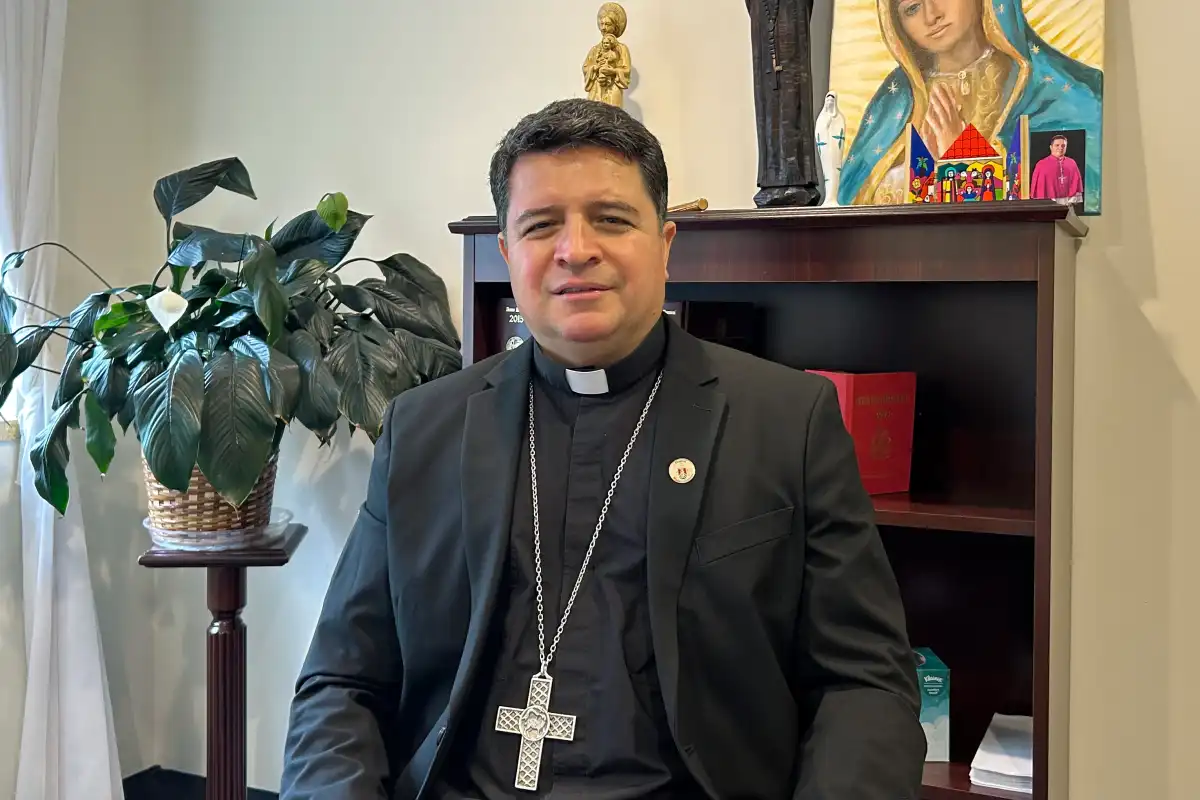
The newly appointed bishop of the Diocese of Wheeling-Charleston, Salvadoran Evelio Menjívar, knows what it is like to arrive in the United States hidden in the trunk of a car, cross borders guided by a “coyote” and carry the stigma of having been undocumented in a country that now lives under Donald Trump’s anti-immigration policies.
Three decades later, this religious man who fled the civil war in El Salvador in 1990 is preparing to carry out his pastoral work in West Virginia, a Republican bastion, at a time of tension between Pope Leo XIV and Trump himself due to their disagreements on immigration or the war against Iran.
From the trunk of a car to the bishopric
«Growing up in El Salvador during the war, there were no opportunities. Young people were at risk of being recruited by the army or guerrillas. “So I got it in my head that I had to leave the country,” he says, recounting what he describes as a mere act of survival.
In a first attempt he traveled to the Mexican city of Tijuana, where he was detained, imprisoned and finally deported, seeing the United States flag on the other side of the border “while saying goodbye”, for the moment, to the “American dream.”
After two other frustrated attempts, Menjívar managed to cross the border hidden in the trunk of a car heading to California, squeezed together with his brother and two cousins.
“I arrived in Los Angeles, a huge, multicultural, multiethnic city, and I came from a small town where I had almost never heard any language other than Spanish,” explains the Salvadoran.
That young man later obtained humanitarian protected status, followed by a religious worker visa and finally US citizenship in 2006.
«I want to be seen as a defender of human dignity»
Now, at 56 years old, Menjívar will be the first Salvadoran bishop in the country’s history in a state where nearly 90% of the population is American and Caucasian and where support for Donald Trump in the 2024 elections was overwhelming.
However, asked about the logic behind his appointment, the bishop does not believe that it is a provocation by the pope towards Trump, but rather a decision consistent with the values of the pontiff, who, remember, was also a missionary in another culture.
«He has not been afraid to make a decision to send me there because he himself was a missionary in Peru. There, even though he was a foreigner, people came to love him because he opened his heart,” he emphasizes.
This reception is what Menjívar now expects from the West Virginia community, that they see him as one of those pastors who “smell like sheep” and are willing to roll up their sleeves to work for the people.
And, in the face of those who describe him as a critic of Trump, he clarifies: “I prefer them to say that I am a defender of immigrants. “Whoever is in the White House, they will have my criticism if the policies go against human dignity.”
The interview took place on the same day that the Secretary of State, Marco Rubio, held a meeting in the Vatican with Leo XIV, which served to iron out differences and which for Menjívar meant a “very good opportunity to work together.”
“It benefits no one that there is no dialogue or that messages are sent that, instead of uniting, divide and, above all, divide the community,” he insists.
A Church that welcomes the migrant
Asked why he would have liked to hear from a bishop when he arrived undocumented, he responded with the verbs that Pope Leo has repeated when talking about migration: “welcome, welcome, protect, promote.”
With that goal, Menjívar now embarks on the task of preaching in a region with hardly any diversity, but where he hopes that people will put aside the stigma that many immigrants carry when they arrive in the United States.
His life, he insists, as well as that of the rest of the people who migrate in search of something better, “cannot be defined solely by the way in which one arrives in the country.”
Menjívar does not care if one arrived hidden in a trunk, with a visa or on a plane. “That’s just part of your story, not all of it,” he concludes.