
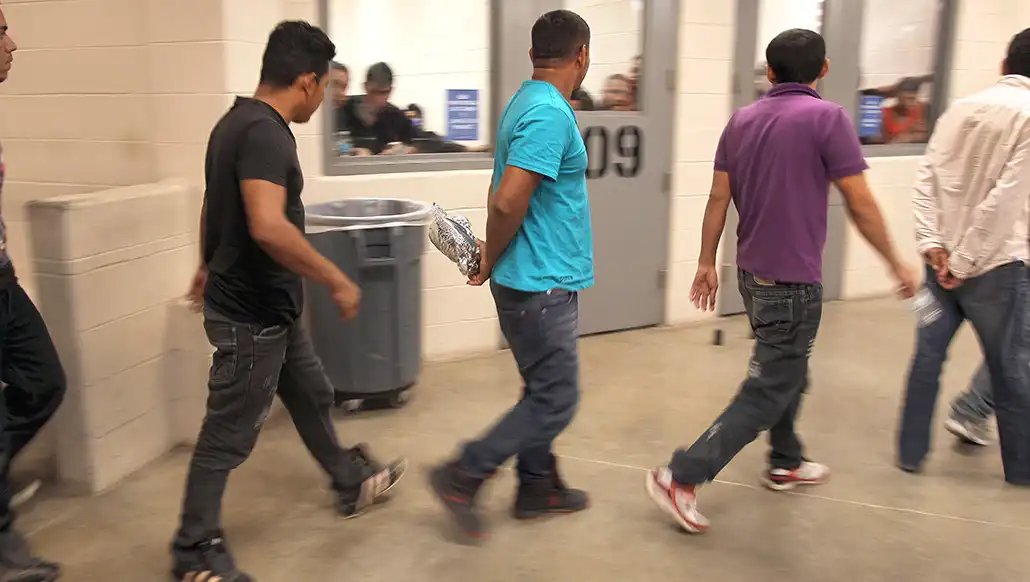
U.S. Immigration and Customs Enforcement (ICE) has dramatically increased arrests and deportations. The New York State Bar Association (NYSBA) urges the passage of legislation that ensures that immigrants have attorneys to represent them in detention proceedings.
The governing body of the New York State Bar Association—the House of Delegates—adopted a report of its Committee on Immigration Representation, pledging the association’s support for legislation that will significantly increase the number of attorneys representing immigrants.
“Overzealous federal actions have made even immigrants with legal status afraid to participate in public life,” said Kathleen Sweet, president of the New York State Bar Association. “We support bills aimed at ensuring that everyone who appears in immigration court receives the legal representation they deserve.”
According to the Vera Institute of Justice, nearly 30% of people facing deportation in New York lack legal representation, while 40% of individuals who have been detained do not have legal representation.
The New York State Bar Association supports the passage of several bills, including the BUILD Act and the New York for All Act.
– The BUILD Act (S4538 / A2689) would provide funding to expand immigration legal services throughout New York State.
Due to cuts in federal funding, many organizations that provide immigration legal services are facing a budget shortfall next year. In addition, a greater number of people require legal services due to the increase in immigration control actions.
– The New York for All Act (S2235A / A3506) would prohibit state and local police departments from assisting ICE in its immigration enforcement efforts.
While Westchester County has outlawed such practices, Broome, Nassau and Rensselaer counties have entered into agreements under section 287(g), which allow local law enforcement to act as federal immigration agents.
The report also recommends that law firms expand their “pro bono” initiatives to represent individuals facing deportation or to assist in federal litigation challenging due process violations in the enforcement of immigration laws.
Additionally, the association will advocate for increased funding for the Office of New Americans, under the New York Department of State.
The New York State Bar Association also supports the passage of the following bills:
– The Sanctuary Hospitals Law (Sanctuary Hospitals Act) (A9589), which would prohibit immigration control actions within hospitals. The association also supports expanding the bill to include more sensitive locations, such as courts, educational institutions and places of worship.
– The Law of Access to Representation (S141 / A270).
– The Law of Dignity, Not Detention (S316 / A4181).
– The SNAP for All Act (A6632), which would create a state-funded program to restore Supplemental Nutrition Assistance Program (SNAP) benefits to those who lost them due to federal restrictions, including immigrants.
– The Fairness for Liberty Act of 2025 (H.R. 3127), which would require the federal government to fund legal representation for immigrants who cannot afford a lawyer.
– The SHIELD Act of 2025 (H.R. 3101), which would establish a federal competitive grant program, renewable every four years, for organizations that provide immigration legal services.
– The Royal Courts and Rule of Law Act (H.R. 7836), which would create an independent immigration court system, similar to the U.S. Tax Court and the U.S. Court of Appeals for Veterans Claims, and separate the operation of immigration courts from political influence.
Karin Anderson-Ponzer chairs the Immigration Representation Committee. Additionally, she serves as director of legal services at Neighbors Link Community Law Practice.
It should be noted that as it celebrates its 150th anniversary, the New York State Bar Association (NYSBA) establishes itself as the largest voluntary state bar association in the nation.
Since 1876, NYSBA has helped shape the development of the law, educated and informed both the legal profession and the public, and defended the rights of New Yorkers through advocacy and mentoring in our communities.