
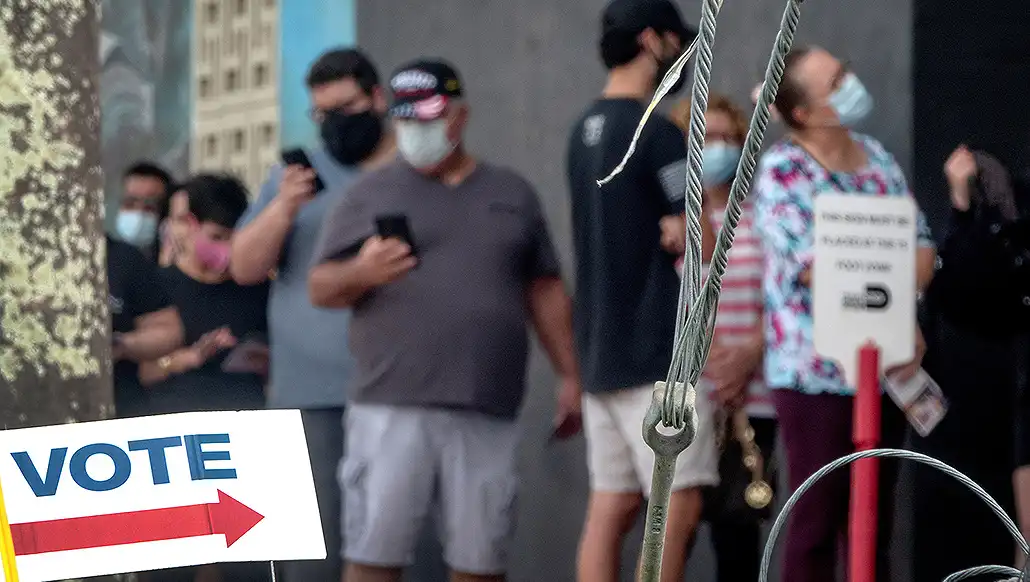
Know your rights in these 2026 elections. The National Police Accountability Project (NPAP) offers a bilingual guide and resources for voters (in English and Spanish) who can thus be more prepared when casting their vote and know what to do if the police or ICE show up at their voting center?
NPAP is a nonprofit organization dedicated to ending abuses by law enforcement through legal action and educational programs.
In the current circumstances that we live in the United States within the second term of Republican President Donald Trump, and in the midst of very polarized legislative elections, many voters have legitimate concerns about the possible intimidating presence of ICE or other law enforcement forces at their polling places on Election Day, this Tuesday, November 3.
For this reason, the new NPAP guide is very timely and necessary since it addresses key points such as: When is the presence of law enforcement in a voting center legal—and when is it not? o Why can’t ICE agents and National Guard troops be legally deployed at voting centers?
It also gives us important step-by-step instructions on what to do if an agent approaches you while you are trying to vote and where to call for immediate help (including help lines in Spanish).
Below is the guide from the National Police Accountability Project (NPAP):
Know Your Rights: Police and Federal Law Enforcement Agents at Voting Centers
The presence of law enforcement officers at polling places can be intimidating to many voters — especially voters of color — and may deter them from exercising their right to vote, which is protected by the Constitution.
Although many voting laws and rules vary by state, this document provides general guidance on your rights when interacting with police and federal law enforcement officials while voting.
1. Is it legal for local police officers to be at my polling place?
Depends. Because local police officers are typically responsible for maintaining order at polling stations and enforcing election laws, they are allowed access to polling stations when election officials or citizens request assistance.
However, there are other circumstances in which a prolonged police presence at a polling place could constitute intimidation or interference with voting under state criminal law.
Some forms of police presence could also infringe on federal voting rights protections. Whether an agent’s presence at a polling place is permissible depends on the specific circumstances, including whether the agent has a legitimate reason to be at or near the polling place, how long he or she remains there or around it, and whether his or her conduct could deter someone from voting.
For example, it would not be illegal for an agent to briefly travel to an electoral voting center to respond to a complaint about an illegal electoral campaign. However, it is likely illegal for an agent to remain at a polling place for an hour checking voters’ driver’s licenses.
2. Is it legal for ICE agents or members of the National Guard to be at my polling place?
No. Federal law prohibits the deployment of federal troops to voting centers. Federal law also restricts the presence of ICE agents and other federal law enforcement at the polls by making it a crime for any federal government employee to interfere in an election.
Because these are federal criminal provisions, the Department of Justice or local U.S. attorneys’ offices have the sole discretion to decide whether these protections apply.
Ahead of the 2026 midterm elections, civil rights organizations have also filed lawsuits seeking a court order preventing federal presence at polling stations. Check to see if there are court-ordered restrictions in your state.
3. What should I do if there are police officers at my polling place?
You may consider informing a member of election staff or an election judge of your presence. In many states, election officials are trained to collaborate with law enforcement officers.
You can also report law enforcement presence to election protection hotlines. 1-866-OUR-VOTE (866-687-8683) is a nonpartisan election protection hotline that can offer real-time assistance to voters experiencing problems at the polls.
The helpline also offers help in Spanish at 1-888-VE-YE-VOTA (888-839-8682).
4. What should I do if I believe there are ICE agents at my polling place?
You should report the presence of ICE to election protection hotlines, such as 1-866-OUR-VOTE, or your local ICE watchdog group.
Voting rights organizations discourage voters from posting on social media or other public forums information about a possible ICE presence in order to reduce misinformation and prevent unrest at voting centers from worsening.
Instead of posting online about ICE’s presence, immediately call an election protection hotline.
5. What happens if an agent or official approaches me while I am trying to vote?
You have the same rights when interacting with a law enforcement officer at a polling place as you do in any public space.
You have the right to ask if you are free to leave. If the answer is yes, consider leaving. If the officer tells you that you are not detained, but that you are not free to leave, it means that you are being held.
Officers may pat you down over your clothing if they have reason to suspect you may be armed and dangerous. If they conduct a more thorough search, say clearly: “I do not consent to being searched.” They may continue to register you anyway. If this happens, do not resist: you could be accused of assault or resisting authority.
You are not required to answer any questions. You are not required to open bags or any other closed containers. Tell the agent that you do not consent to search of your bags or other personal items.
You also have the right to ask the agent for their information. Try to find witnesses who were at the scene and write down their names and phone numbers.
If you are injured, seek medical attention and take photographs of the injuries as soon as you can. Call a lawyer as soon as possible.
Although you have the same rights when interacting with a police officer, you should be aware that state election laws may impose restrictions on your First Amendment rights while in or around a polling place, including your right to express support for a candidate and to speak loudly.
6. What can I do to limit law enforcement presence at my polling place in the future?
State and local election officials have discretion to regulate their elections and can enact laws and regulations that limit the presence of law enforcement at polling places.
For example, New Jersey has enacted a law prohibiting law enforcement from being within 100 feet of a polling place on Election Day unless responding to a request for assistance.
Bills limiting police presence at voting centers have been introduced in other states. You might consider supporting these types of measures to strengthen protections against intimidation and harassment by law enforcement at polling places in your state.