
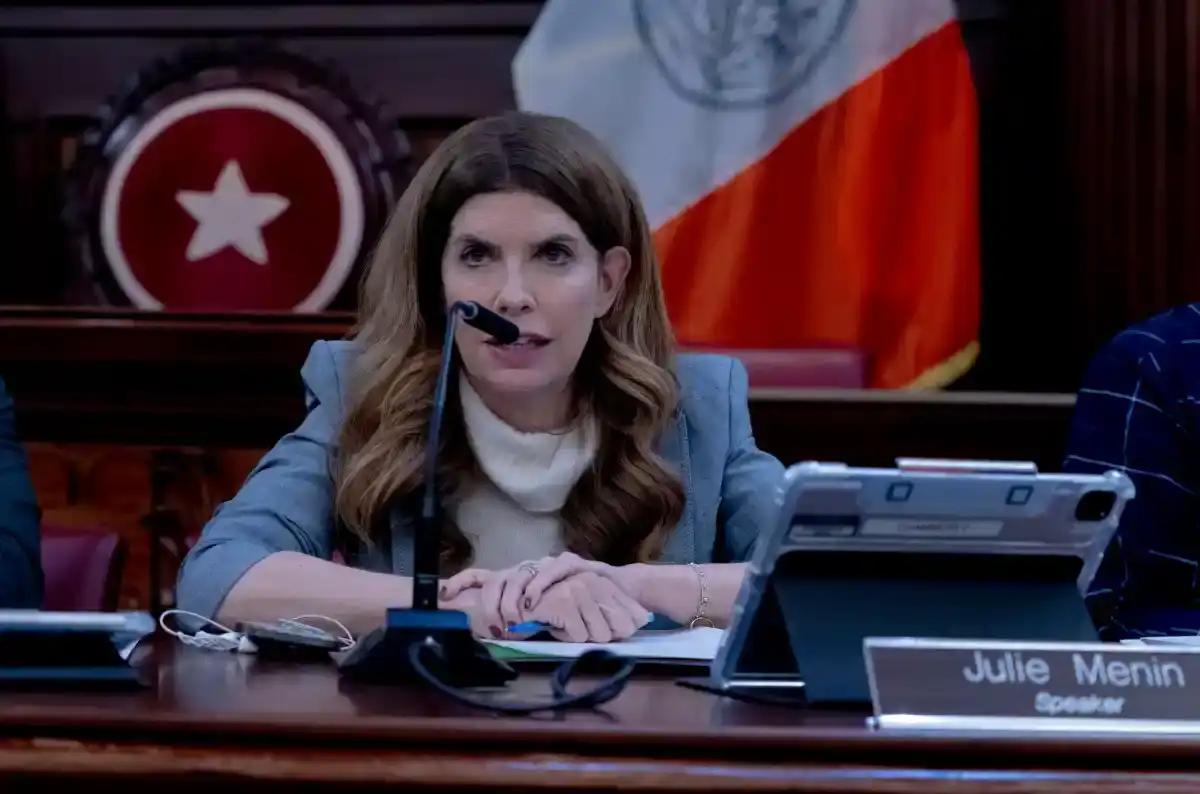
New York City Council Speaker Julie Menin has asked leaders of 10 universities to explain at a hearing next month how they investigate allegations of sexual assault and protect their students, following several high-profile cases at Cornell and the Fashion Institute of Technology (FIT).
The hearing, scheduled for Dec. 15, will examine how institutions investigate these incidents, discipline students found responsible, and monitor fraternities and other campus organizations.
According to state data, the 10 institutions collectively recorded 1,100 complaints of sexual misconduct during 2024, but only reported six expulsions and 10 suspensions.
Of those incidents, only 129 (12%) resulted in a request for formal disciplinary proceedings. In the remaining 971, this process did not begin. This category includes cases in which the university lacked jurisdiction or could not move forward for other reasons, although the data does not specify the individual reasons.
Of the cases formally processed, the defendants were found responsible in 30. The universities also reported another 15 sanctions that did not involve suspension or expulsion.
The numbers, reported under the state’s Enough Is Enough law, include reports of sexual assault, dating violence, domestic violence and stalking.
In a Nov. 9 letter to Jennifer Mnookin, president of Columbia University, Menin said the Council wants to identify deficiencies in university policies.
“These incidents can leave lifelong scars, disrupt studies, undermine confidence in institutional responses, and cause lasting harm to affected individuals and university communities,” he wrote.
The Council sought participation from leaders from Columbia, New York University, CUNY, Fordham, St. John’s, Pace, Touro, The New School, Mercy University and Yeshiva University. The invitations are voluntary, but officials expect institutions to cooperate.
The hearing will also address Enough Is Enough compliance, support for survivors, and collaboration with law enforcement. Students and advocacy organizations will also be able to testify.
Recent cases prompt review
Menin pointed to the Cornell and FIT cases as reasons for calling the hearing.
At Cornell, a former student filed a civil lawsuit in September alleging that a group of students drugged and raped her in October 2024. She also maintains that the university did not adequately punish those responsible.
Gov. Kathy Hochul appointed Attorney General Letitia James as special prosecutor to investigate the case. On Nov. 4, James announced that former federal prosecutor Jacqueline Kelly would lead the investigation as outside counsel.
At FIT, federal prosecutors announced charges in October against Moises Freire, 19, accused of supplying fentanyl to two students at a Manhattan college dorm in March. Both were left unconscious and one was raped, according to the accusation.
Prosecutors maintain that Freire falsely told them the substance was cocaine. One of the young women fell into a coma and died on March 21; the other survived. Freire, who was not a FIT student, had pleaded not guilty to previous drug charges and had not yet appeared before a judge for the new allegation.
Neither Cornell nor FIT were invited to testify. Cornell is in Ithaca, outside the city, while FIT is part of the State University of New York (SUNY) system. One official explained that its affiliation with SUNY limits the Council’s oversight jurisdiction.
Although there are no bills planned before the hearing, councilors could consider new measures based on testimony.
The hearing will begin at 10 a.m. Dec. 15 at City Hall.