
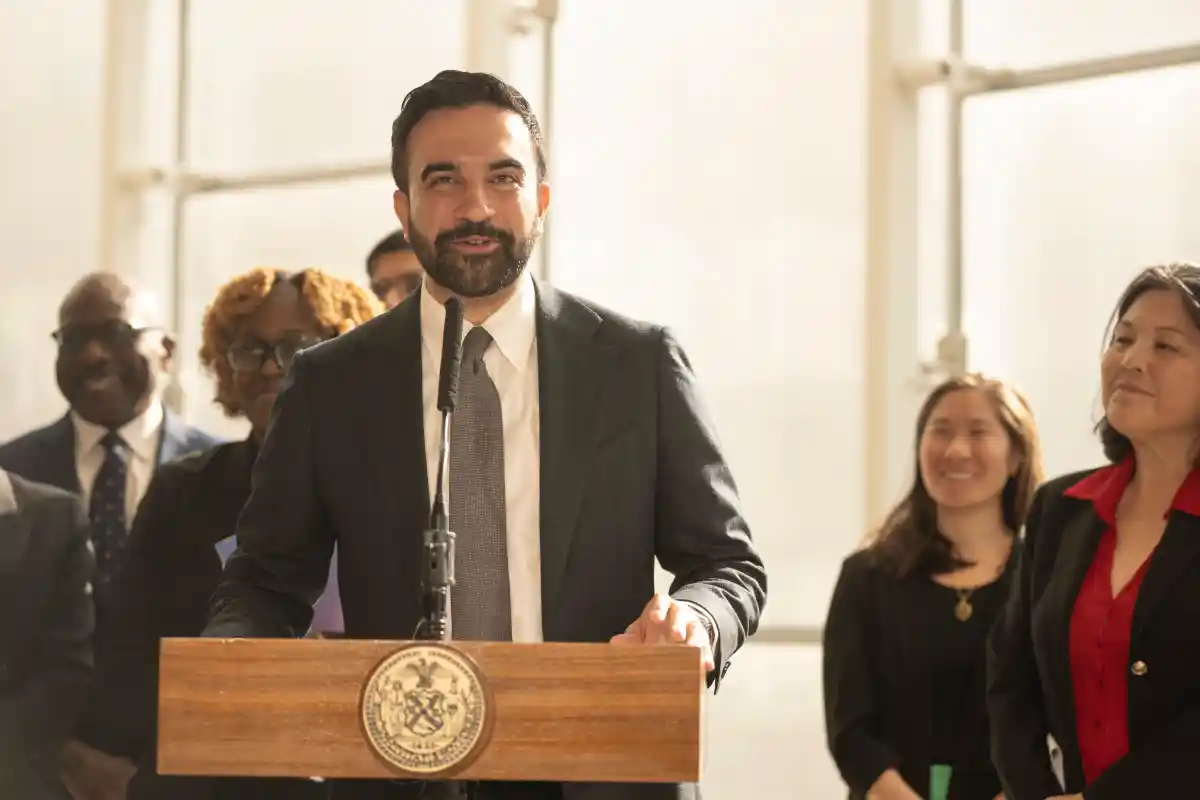
Mayor Zohran Mamdani presented a new report on Monday that reveals a compelling reality: 62% of New Yorkers – some 5.04 million people – do not have the necessary resources to cover the true cost of living in the city. Among them, Latinos are the most affected, with 78% not reaching that threshold.
The report, the first to measure the so-called “real cost of living,” establishes what families need to cover essential expenses such as housing, food, health care, child care, transportation, taxes, savings and other basics. Although 3.58 million residents are above traditional poverty metrics, they still do not have enough income to live in the city.
For families with children and adults under age 65, the report sets the average annual threshold at $159,197. It also estimates that those who don’t meet that level face an average gap of $39,603 a year between their income and their expenses.
Mamdani submitted this report along with the first draft of the city’s racial equity plan, a document required by charter changes approved by voters in 2022 and not released during the Eric Adams administration. The mayor explained that his team inherited the work in progress, expanded it into a broader analysis spanning 45 agencies, more than 200 goals and more than 600 indicators, and decided to publish it for public comment.
“In this, we inherited work that was already underway, strengthened it, and then made the decision to put it in front of New Yorkers,” he said.
On his 15th day in office, Mamdani appointed organizer and attorney Afua Atta-Mensah as chief equity officer and commissioner of the Office of Racial Equity and Justice, and pledged to release the plan within his first 100 days. He presented the report as a legal obligation and as a test of whether the municipal government can turn its equity commitments into concrete actions.
During a press conference in Brooklyn, Mamdani stressed that both reports should be read together.
“The true cost of living measure confirms what New Yorkers have known for a long time: Too many people can’t afford the city they love,” he said.
He added that “this draft racial equity plan is the first step in developing a whole-of-government approach to address that reality.”
The racial equity plan organizes the agencies’ work in seven key areas: children, youth, older adults and families; economy; housing and preservation; infrastructure and environment; health and well-being; community safety, rights and accountability; and governance and inclusion in decision-making. The agencies evaluated their functions in areas such as services, personnel, hiring and budgets, and established short, medium and long-term goals.
The report identifies common themes among the agencies, such as budget reallocation, equitable service delivery, investing in underserved communities, repairing historic harms, institutional strengthening, and supporting minority- and women-owned businesses.
It also highlights commitments such as promoting pay equity, reviewing fines and fees, investing in high-need neighborhoods, expanding the MyCity platform with a focus on underserved communities, and strengthening educational and employment opportunities for public school students.
The City Council presented the plan as a tool of both public policy and accountability. According to the document, agencies should use the final version to guide “policy, operations, and accountability across government.” During the event, Atta-Mensah stated: “Our responsibility now is to move from planning to action… because plans alone do not create change; actions do.”
The report also reveals deep inequalities between racial and ethnic groups. Hispanic New Yorkers have the highest rate of people below the threshold, at 78%, followed by Black New Yorkers at 66% and Asian and Pacific Islanders at 63%. By comparison, 44% of white residents are falling short of the real cost of living.
Furthermore, 73% of children in the city live in families that do not meet that threshold. By county, the Bronx has the highest proportion of residents in this situation with 75.1%, followed by Brooklyn with 61.5% and Queens with 61.1%. Manhattan clocks in at 55.6%, while Staten Island has the lowest rate at 48.2%.
The report notes that government programs such as stabilized housing, SNAP, tax credits, and free Pre-K and 3-K education reduce the rate of people below the threshold from 67% to 62% citywide.
Public Advocate Jumaane Williams also emphasized the need for action: “Plans alone don’t change lives; actions do,” and noted that the city’s budget will need to reflect these findings.
-Translation and editing by Karmina L. Fonseca