
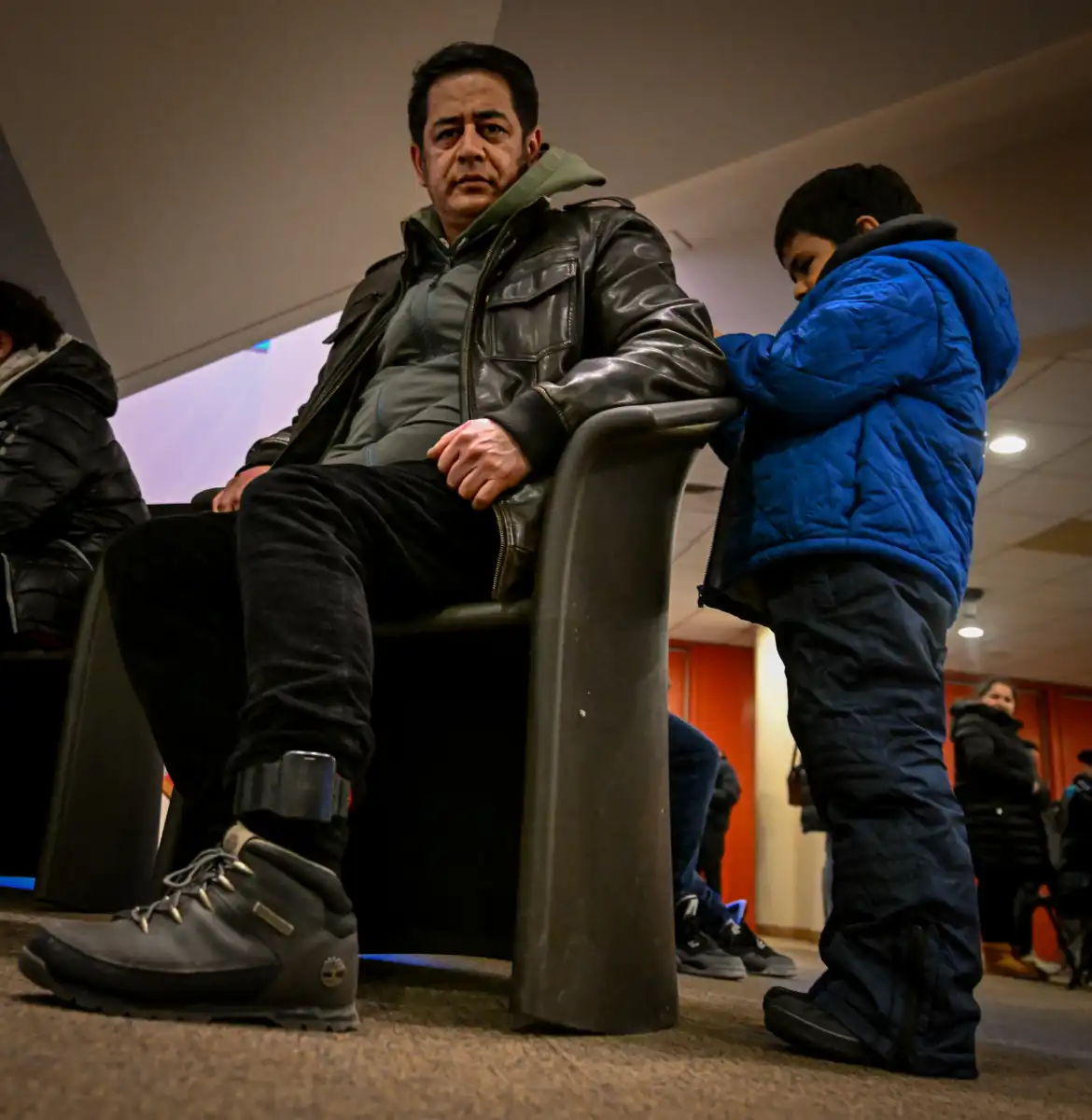
German Gálvez was inside Saint Peter’s Church in Midtown Manhattan on a Sunday morning in early February. The mass had just concluded and the 47-year-old Ecuadorian asylum seeker was waiting with his seven-year-old son, Sergio, to receive free legal advice offered by the church.
As other families reviewed their own immigration documents, with their futures at stake, Gálvez pulled up his pants to display an electronic monitor on his ankle, a constant reminder of his detention earlier this year and the difficulties he now faces to keep his family financially stable.
In early 2026, Gálvez became the first person detained in the 26 Federal Plaza building. Authorities kept him in custody for four days, from January 8 to 12, after he attended a check-in appointment with ICE immigration agents.
“I had never been arrested in my life,” Gálvez told our sister publication, amNewYork. “It was terrible for me, but in the end I accepted everything because I have experienced what no one would want to experience. For the sake of my family, I said: ‘I want them to be safe.'”
Detention in desperate conditions
Authorities held him for two days on the 10th floor of Federal Plaza, a location that U.S. Rep. Dan Goldman and other immigrant advocates have called inadequate for holding detainees.
Gálvez assured that he did not have access to a shower or a bed, a situation that came to light in the summer of 2025 after the leak of a video that showed that the detainees did not have private spaces to sleep and had to share a bathroom.
The situation plunged him into despair, not so much for himself, but for his family.
“My heart exploded with sadness. I was very sad,” Gálvez said, explaining that he constantly thought about his loved ones. “They depend a lot on me, and I didn’t know what to do.”
After his release, authorities placed an electronic monitor on his ankle for almost a month and a half, something he described as endless torture.
According to the Ecuadorian immigrant, the device caused him constant pain and sleepless nights, in addition to making it difficult for him to care for Sergio, who suffers from polycystic kidney disease, a disorder that causes fluid-filled cysts to form in the kidneys.
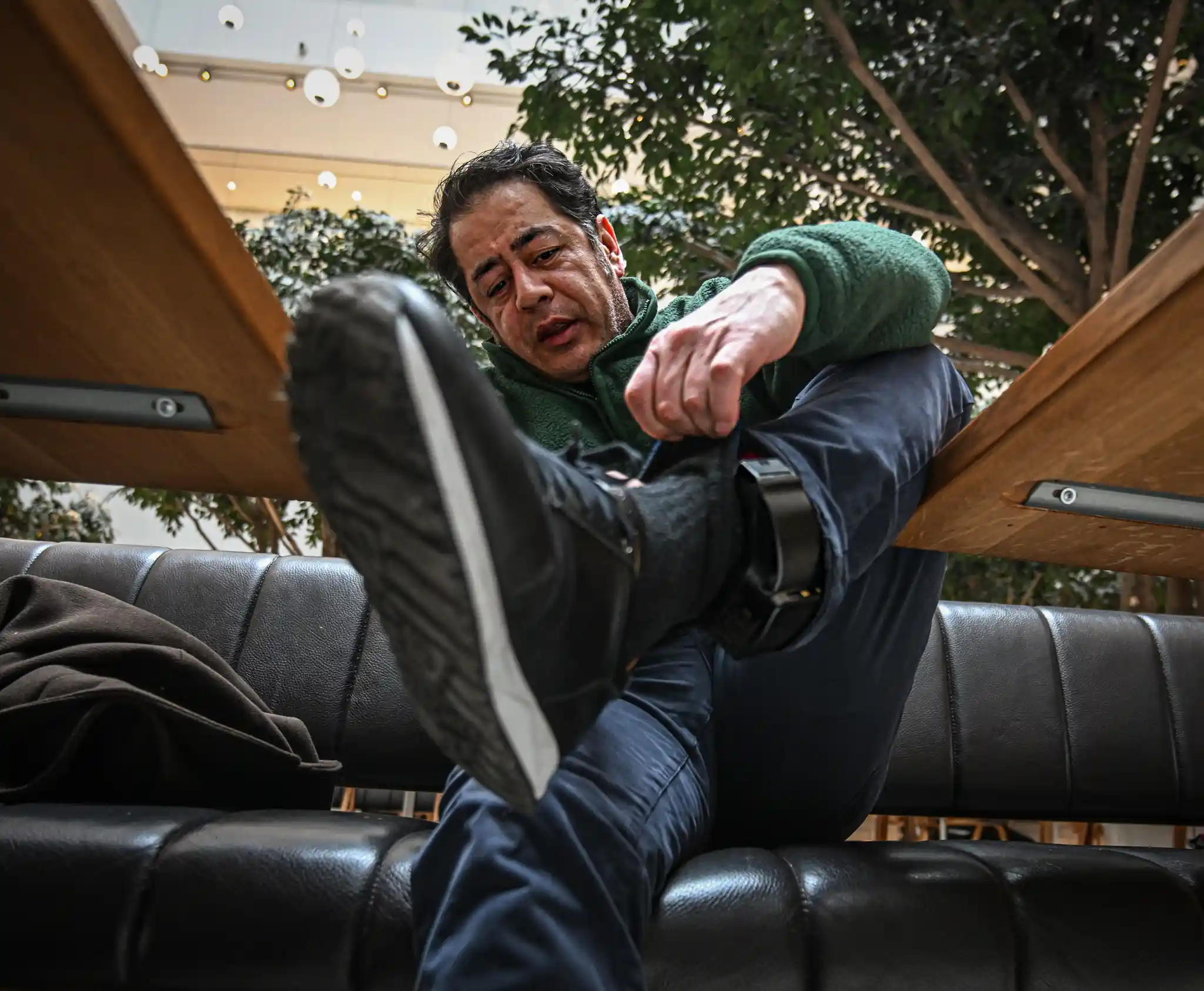
In addition to the physical pain, the monitor represented an additional financial burden. Gálvez explained that he had to choose between buying food or spending the little money he had on sports bandages to relieve the pain.
“I used to wear sports bandages to dull the pain, but unfortunately, there is no money to buy them. They cost between $15 and $20, and it is very sad because I have to use that money on the bandages when I could spend it on a gallon of milk,” he confessed.
Gálvez said he reached his breaking point until, with the help of a lawyer, he finally got the electronic monitor removed and felt a weight lifted off his shoulders.
Currently, the Gálvez family lives in a shelter hotel in Manhattan, where they are not even allowed to cook. They hope to find permanent housing, although they recognize that the outlook is uncertain, since they have difficulty even buying food.
In Ecuador, Gálvez had his own house and owned a business, a pool hall. However, he assured that he had to abandon everything after receiving death threats. As he explained, due to corruption in the country, local political groups pressured him to allow the sale of drugs in his establishment, which made him the victim of several robberies and even a kidnapping.
After fleeing through different Ecuadorian cities to escape threats, he and his family left the country in November 2022.
“I couldn’t have anything in my name because I was an easy target. They told me I had to leave because they were going to kill me. We had nowhere to report because everything was corrupted by this group of criminals,” he said.
Gálvez, his wife Maya — who suffers from hypothyroidism — and their children arrived in the United States in December 2022, after a month of traveling through several Latin American countries. They first settled in Pennsylvania and New Jersey, then moved to New York City in August 2024.
Currently, the family supports itself with temporary jobs. His wife cleans houses and Gálvez works in construction, although he assures that he looks for any job that allows them to get out of their situation.
As he waits for his next hearing scheduled for July, Gálvez fears that the United States government will send his family back to a country where he believes his life would be in danger.
“We are going to fight to achieve a good life, to take care of my family as best as possible, so that my children, who are good people, can help strengthen this nation,” he concluded.