
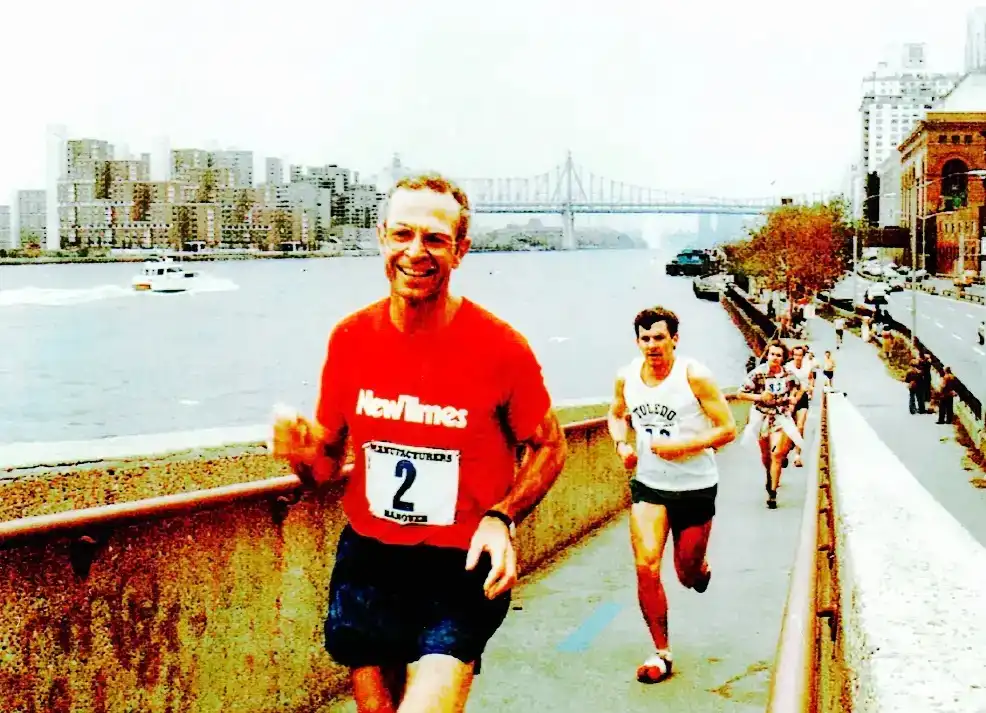
The last living founder of the New York City Marathon route through the five boroughs remembers how everything came together to transform the competition into an international event.
George Hirsch is the editor of New York Magazine and an active enthusiast. At 92 years old, he still runs on the treadmill and, a couple of years ago, started boxing.
Although he had been a runner his entire life, Hirsch didn’t start taking the exercise seriously until the second half of the 1960s. “People thought of runners as a little strange, like weirdos,” Hirsch recalls.
That all changed when American Frank Shorter won gold in the marathon at the 1972 Olympics. Additionally, during the 1970s, other factors converged around running.
“The awareness of self-care and fitness,” explains Hirsch; Well-being became something that allowed us to improve the quality of life.
The 1970s are considered the time when running gained widespread popularity, giving Hirsch and his four co-founders an excellent opportunity to launch a city-wide marathon. According to Hirsch, at the time, “The idea of an urban marathon was unknown. “It didn’t exist.”
New York City held its first marathon in 1970, which consisted of four laps of Central Park. However, Hirsch had a more ambitious vision for what NYC could achieve in the realm of athletics.
To make that vision a reality, Hirsch teamed up with four other passionate runners, all of whom are influential and tenacious:
– Percy Sutton, Manhattan Borough President;
– George Spitz, a restless and persistent character in New York public life—known for running for various municipal offices out of pure hobby and for campaigning at any time of the day or night—;
– Ted Corbitt, recognized in the then small and close-knit running community for having been the first African-American man to represent the United States in an Olympic marathon; and
– Fred Lebow, Holocaust survivor, originally from Arad (Romania) and president of New York Road Runners.
The Five Borough Marathon (5-Boro Marathon): Yesterday and Today
When Hirsch and his co-founders pushed their idea of creating a city-wide marathon, they encountered little resistance. At the time, NYC “was on the brink of bankruptcy and crime was through the roof,” Hirsch recalls.
Five decades later, the New York city has experienced many changes, as has the marathon.
Currently, potential participants only have a 1% chance of being admitted to the trial. Demand to participate has grown tremendously since 1976. According to Hirsch, New York Road Runners sells out its events every week.
Once the course was approved and he was already at the starting line on Staten Island, Hirsch contemplated the almost unreal environment that surrounded him next to the Verrazzano Bridge: helicopters flying over the area and tugboats launching jets of water.
The spectacle continued when, after crossing the Queensboro Bridge, the runners turned onto First Avenue. At that point in the race, Hirsch realized that, “even before we finished, we knew this was going to be a success.”
The memory that Hirsch keeps most fondly of that first marathon of the five boroughs is that of the moments after crossing the finish line.
Completely exhausted, Hirsch spotted Frank Shorter, who had placed second behind Bill Rogers. Both had to go to the center of the city. As they left Central Park, Hirsch turned to Shorter, realizing that he was missing something fundamental to get to downtown:
«—Frank, I don’t have any money. —He responded that he didn’t have one either. So we started hitchhiking on Central Park West. Two men who had come from Philadelphia to watch the marathon stopped. We got on and they asked us where we were going. Then one of them looked in the rearview mirror and exclaimed, “Oh my God, it’s Frank Shorter!” I told him: “Let’s go to 32nd Street.” And the driver responded: “How about Miami?”
For Bill Rodgers, however, a much grimmer situation awaited him after experiencing the supreme euphoria of crossing the finish line first. As he was carrying his trophy to the place where he had parked, he got an unpleasant surprise: his car was no longer there; The tow truck had taken it away.
Gary Muhrcke: Winner of the first NYC Marathon
After becoming the first winner of the New York Marathon in 1970—when the event simply consisted of running around Central Park four times—Gary Muhrcke continued running after the creation of the five-borough marathon (“5-Boro Marathon”).
Although he achieved glory in the 1970 edition, he prefers the variety of terrain offered by the new five-borough tour. “Running a marathon around a circuit is not the most fun thing in the world,” says Muhrcke.
Although he is no longer training to complete the 42.195 kilometers (26.2 miles), Muhrcke remains aware of how the sport has evolved. At the time he participated in the marathon, the stopwatch stopped at 4 hours, since the participants were much more competitive in terms of their race times.
“They were much more serious runners,” says Muhrcke; “Nowadays, people participate more to fulfill a personal goal, something they had on their wish list.”
The role of the marathon in the city since its beginnings
Since its inception in 1976, the Five Borough Marathon has served as a unifying element for the city. Hirsch cites the 9/11 attacks as a prominent example: they occurred just six weeks before the marathon was held.
New Yorkers needed the marathon as a tool to foster camaraderie after an event as devastating as 9/11.
The number of spectators exceeded the number of participants, given that, as Hirsch explains, “a third of the runners come from abroad.”
For Hirsch, it is precisely this international character that distinguishes the New York City Marathon (TCS New York City Marathon) from the others:
«Boston is traditional; Chicago and Berlin are flat and fast routes; but New York stands out for its international dimension. It is, in a way, a global city. Therefore, it is the global marathon.
(Reporting by AMNY.com’s Aidan Levin)