
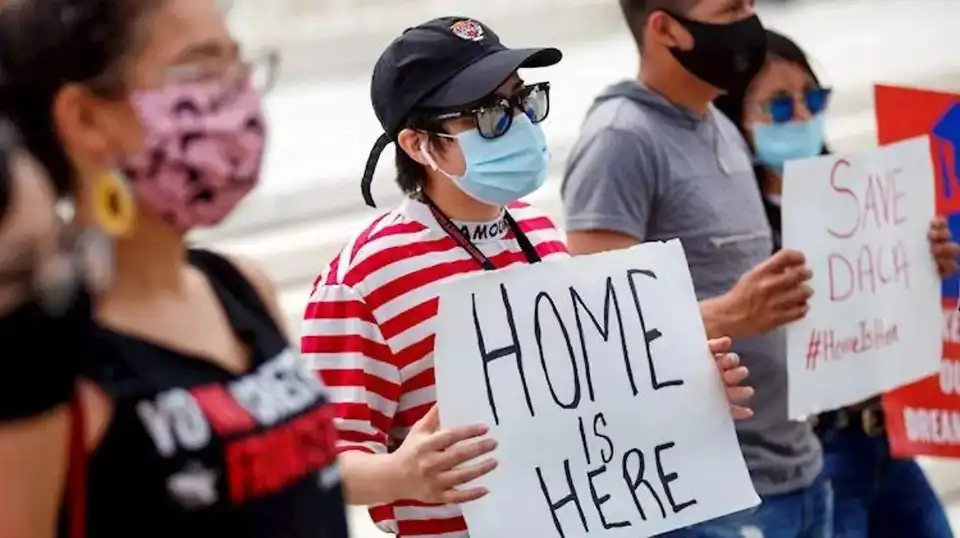
Juliana Macedo do Nascimento came to the United States from Brazil at the age of 14 and here, now 40, she has built her entire adult life. The Deferred Action for Childhood Arrivals (DACA) program, created in 2012 by then-President Barack Obama, gave her hope for stability and a future: it protected her from deportation and granted her a work permit.
Now, 14 years later, the program is going through one of the most uncertain times in its history. President Donald Trump’s administration has detained hundreds and deported dozens of recipients and maintains that DACA does not protect them from expulsion.
Macedo, who currently works as an immigrant rights activist at United We Dream, assured that the so-called “dreamers” are being persecuted by the Government.
DACA was created through executive action to protect young people who came to the country as children from deportation. Although it does not offer a path to citizenship or permanent immigration status, it allows them to obtain work permits and temporarily suspends removal orders.
The most recent records from the Citizenship and Immigration Services (USCIS) show that, as of December 2025, there were 495,320 active DACA recipients in the country. Most were born in Mexico, followed by Guatemala and Peru.
The legality of the program has been in dispute for years. During Trump’s first term, the Administration attempted to end DACA, but the Supreme Court blocked the measure in 2020, considering that the procedure used was inadequate.
However, legal disputes continued and in January 2025 a federal court again concluded that parts of the program were illegal, although it allowed current beneficiaries to continue renewing it while the case moves toward a possible Supreme Court review.
Between January and November 2025, Immigration and Customs Enforcement (ICE) arrested 261 DACA recipients and deported 86, according to Department of Homeland Security (DHS) data confirmed by Democratic Senators Dick Durbin, Alex Padilla and Mark Kelly.
Under the Trump Administration, DHS maintains that DACA does not protect against deportation and has asked recipients to “self-deport.” In April, furthermore, the Board of Immigration Appeals, the highest administrative court in immigration matters, concluded that having DACA is not enough to stop an expulsion.
“This Administration has taken a different approach than its first term,” Macedo explained. «The first time they tried to end DACA suddenly and saw the reaction; “This time they are wearing it down little by little.”
According to the activist, the Government has also eliminated DACA recipients’ access to subsidized health coverage through the Affordable Care Act and has promoted measures to restrict certain state educational aid.
Additionally, processing times to renew DACA have lengthened considerably. Procedures that used to be resolved in one or two months can now take between 6 and 8 months, according to Macedo. “People lose their work permits, their jobs, their access to health care and protections against deportation,” he said.
Democratic Congressman Jesús “Chuy” García attributed the uncertainty to “the lack of action by Congress to approve immigration reform” and recalled in statements to EFE that households with DACA beneficiaries pay about $9.5 billion annually in federal and local taxes.
For his part, the president of the FWD.us organization, Todd Schulte, warned in a statement that the program is “under imminent attack” due to the delay in renewals and the increase in arrests, while the recent budget approved by Congress will allocate hundreds of billions of dollars to ICE and border control.
DACA stopped accepting new applications in 2017 and currently only allows renewals for those who were already enrolled, while its future remains pending court decisions.