
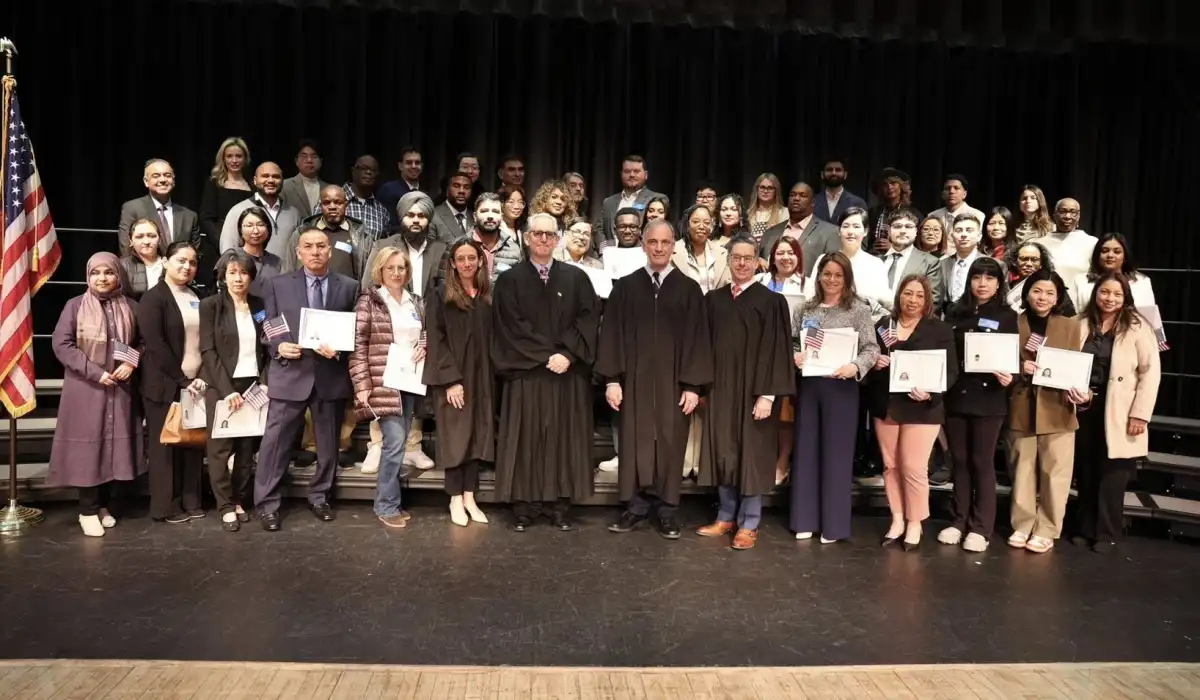
Fifty immigrants from around the world became American citizens on Thursday, March 26, during a historic naturalization ceremony held at Paul D. Schreiber High School in Port Washington, Long Island, NY.
This event marked the first time such a ceremony has been held at the school and only the second time a Nassau County public school has hosted a federal naturalization proceeding.
The ceremony, organized by the federal court for the Eastern District of New York, the United States Citizenship and Immigration Services and the Justice for All: Courts and the Community initiative, transformed the school auditorium into a courtroom, offering students—and the community at large—a unique opportunity to observe the naturalization process firsthand.
Federal Magistrate Judge James M. Wicks presided over the ceremony and administered the Pledge of Allegiance to the 50 candidates, who came from 25 countries in Europe, Asia, Africa and the Americas. The event was broadcast live throughout the Port Washington Unified School District, allowing students in classrooms across the district to witness the ceremony in real time.
“This is a historic naturalization ceremony,” Wicks said. “It’s particularly special to do it outside the confines of a courtroom… and even more special to do it in a school like yours.”
The initiative behind this event has its roots in civic education. The “Justice for All” program, founded by former Chief Justice Robert A. Katzmann, seeks to build bridges between the judiciary and citizens, bringing judicial proceedings to community settings.
School officials noted that the ceremony was a powerful learning experience for students studying government and civic education subjects.
Superintendent Gaurav Passi described the moment as something no classroom lesson could replicate.
“There is no lesson or textbook capable of replicating this moment,” Passi declared. «Citizenship is much more than a formal legal procedure; “It is an invitation to participate, to contribute and to help shape this place and its future.”
Passi, who shared his own experience as a naturalized citizen, emphasized the deeper meaning of this milestone, calling it “both an end and a beginning” for those taking the oath. “What I now understand is that citizenship is much more than a formal legal procedure,” he said. “It is an invitation to participate, to contribute and to help shape this place and its future.”
The ceremony included the presentation of the national colors, the singing of the national anthem and the participation of student musicians, thus reinforcing the link between the civic process and the school community.
Additionally, high school students helped lead the Pledge of Allegiance and distributed American flags to new citizens after the oath was taken.
In his keynote address, U.S. Circuit Judge Joseph Bianco welcomed the candidates and underscored the significance of this moment, both personally and nationally.
“As you sit there, know that you are Americans now,” Bianco said. “The United States of America is, by virtue of that oath, both your country and ours. “Don’t ever forget it.”
Bianco urged the new citizens to assume the responsibilities inherent to their new status, including civic engagement and participation in democracy.
“I encourage each of you to be active citizens,” he said. «I encourage you to vote. “I encourage you, if you see something wrong, to raise your voice and express your opinion.”
He also highlighted the fundamental values of the nation, emphasizing equality and legal guarantees.
“Each of you are guaranteed equal protection under the laws of the United States,” he stated. “If someone tries to discriminate against them, the courts are here to defend them.”
Students played a prominent role in the ceremony, further reinforcing its educational purpose. Kamila Drozdowicz, 2nd year student. year, shared his own experience immigrating from Poland and adjusting to life in the United States.
“Being an American is not about where you come from, but rather how you contribute,” Drozdowicz said. “Their experiences, their cultures, and their voices are now part of American history.”
He described the challenges of starting over in a foreign country, but emphasized the opportunities that arose later, including finding a supportive community and a sense of belonging.
The ceremony also included interventions by one of the newly naturalized citizens, Fraser Kennedy, who recounted his journey from a small village in Scotland to building a life on Long Island.
“I am extremely grateful and honored to become a citizen of this country,” Kennedy said. “It is my hope that we do not lose the sense of gratitude we feel here today.”
Kennedy described his arrival in the United States in 2022 and how he built a career and a family, noting that he and his wife are expecting their first child later this year.
The 50 new citizens represented a diverse range of nations, including Albania, India, Jamaica, Italy, Pakistan and the United Kingdom, reflecting the global nature of immigration to the United States.
Throughout the ceremony, speakers emphasized that diversity as a strength and distinctive feature of the country.
“Their experiences, their cultures, and their voices are now part of American history,” Drozdowicz said.
Officials explained that the choice of a school as the setting for the ceremony was intentional, designed to integrate the work of the federal courts into the daily life of the community and inspire students to better understand their government.
As the ceremony concluded amid musical performances and applause, Wicks reflected on the broader meaning of that moment.
“Our country is strengthened every time a new citizen raises his hand and takes that oath,” he said. “So today we got a little stronger.”
For the new citizens, the event marked the culmination of years of effort and the beginning of a new chapter; one that now includes full participation in American civic life.